filed in
Year-End Bookkeeping Checklist for Small Businesses in New Jersey
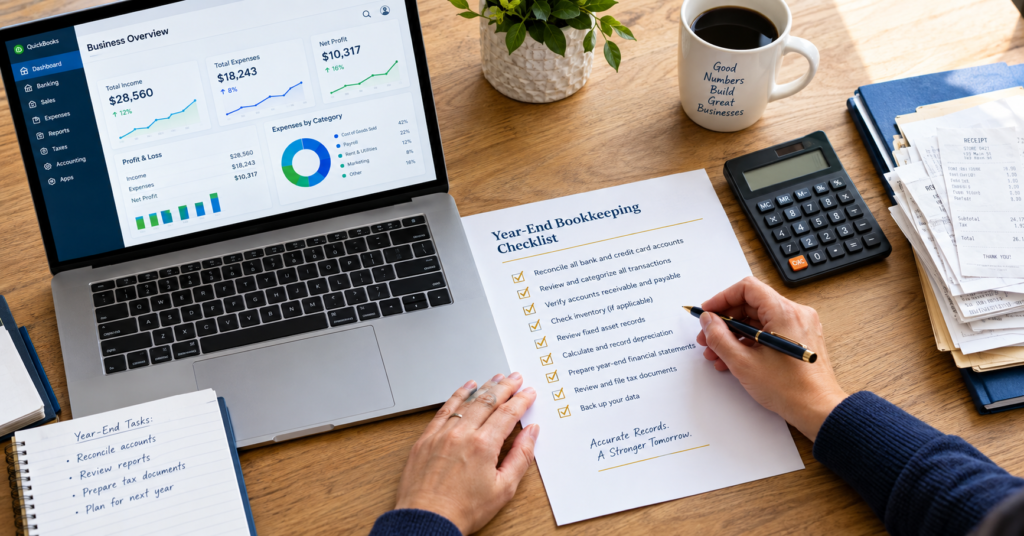
A year-end bookkeeping checklist is the difference between walking into tax season prepared and spending January chasing receipts. For small businesses in New Jersey, closing out the year means reconciling every account, collecting W-9s from contractors, reviewing payroll records against your NJ-927 filings, and confirming that sales tax returns are current. Get these steps done before December 31 and your CPA can file accurate returns without delays or surprises.
Most of the business owners we work with across Bergen County, Passaic County, and Northern New Jersey are not behind because they lack discipline. They are behind because no one gave them a clear sequence of what to do and when to do it. This checklist covers the ten steps that matter most, in the order they should happen, starting in October.
Why does year-end bookkeeping matter for NJ small businesses?
Year-end bookkeeping is when you close out your accounting period, verify that every transaction is recorded correctly, and prepare the records your CPA needs to file your tax returns. For New Jersey businesses, the stakes are higher than in most states because NJ layers multiple tax obligations on top of federal requirements.
| Definition: Year-end bookkeeping is the process of reconciling all accounts, verifying income and expense records, preparing contractor and payroll documentation, and closing the books for a completed fiscal year so financial statements are accurate and tax returns can be filed on time. |
New Jersey’s Corporation Business Tax rate reaches 9% on net income above $100,000 for C corps and S corps. The state charges a 6.625% sales tax that requires quarterly filings on Form ST-50, even in quarters when you collected nothing. Payroll reporting includes NJ income tax withholding, unemployment insurance, temporary disability, and family leave insurance, all filed quarterly on Form NJ-927. Missing or inaccurate filings in any of these areas trigger penalties and interest from the New Jersey Division of Taxation.
Clean year-end books also affect decisions beyond taxes. Lenders reviewing your financials for a loan, landlords evaluating a lease application, and potential partners doing due diligence all rely on accurate financial statements. If your books do not reconcile, those statements cannot be trusted.
When should you start your year-end close?
Start in October, not January. A three-month runway gives you time to catch errors, chase missing documentation, and resolve discrepancies without the pressure of a filing deadline. Waiting until after the holidays compresses everything into a few frantic weeks when your CPA is already booked with other clients.
| Month | Focus Area |
|---|---|
| October | Reconcile all bank and credit card accounts through September. Identify missing receipts and unreconciled transactions. |
| November | Collect W-9s from all contractors. Review payroll records. Confirm Q3 sales tax and estimated payments were filed. |
| December | Record final transactions. Run preliminary profit and loss and balance sheet. Prepare 1099 data. Close the books. |
| January | File 1099-NEC forms (due January 31). Deliver year-end financials to your CPA. |
This timeline works for calendar year filers, which covers most small businesses. If your fiscal year ends on a different date, shift the same sequence to start three months before your close.
What are the 10 steps in a year-end bookkeeping checklist?
These ten steps cover the core year-end close for a New Jersey small business. The order matters because each step builds on the one before it. Reconciliation comes first because everything else depends on accurate account balances.
1. Reconcile every bank and credit card account
Match every transaction in your bookkeeping software to your bank and credit card statements, January through December. Flag any transactions that do not match, any duplicates, and any charges you do not recognize. This is the foundation of your year-end close. If account balances do not reconcile, your financial statements are unreliable.
2. Review and correct transaction categories
Pull up your chart of accounts and scan for miscategorized transactions. Common problems we see with Northern NJ business owners include personal expenses recorded as business expenses, meals categorized as office supplies, and loan payments showing up on the profit and loss statement instead of the balance sheet. Each miscategorization affects your tax return.
3. Confirm accounts receivable and accounts payable
Review your outstanding invoices. Are there customers who still owe you for work completed this year? Follow up now while there is still time to collect before year-end. On the payable side, check for vendor bills that have not been recorded. Any expense you paid in 2026 needs to appear on this year’s books.
4. Collect W-9 forms and prepare 1099 data
If you paid any independent contractor, freelancer, or unincorporated vendor $2,000 or more during the 2026 tax year, you are required to file a 1099-NEC. The filing deadline is January 31, 2027. Collect a completed W-9 from every contractor now, not in January when they are harder to reach. Record each contractor’s name, tax ID, and total payments in your bookkeeping software so generating the forms takes minutes.
| New for 2026: The One Big Beautiful Bill Act raised the 1099-NEC reporting threshold from $600 to $2,000 starting with the 2026 tax year. For payments made in 2025, the $600 threshold still applies. Make sure you are using the correct threshold for the right tax year. |
5. Review payroll records
Cross-reference your total payroll expenses in QuickBooks or Xero against your quarterly Form 941 filings (federal) and NJ-927 filings (state). Gross wages, employer-paid taxes, and benefit contributions should match exactly. Payroll is often the largest expense for a New Jersey business, and it is also where errors carry the most risk, including personal liability for business owners who underpay withholding.
6. Verify quarterly sales tax filings
Confirm that all four quarterly sales tax returns (Form ST-50) were filed for the year. New Jersey’s 6.625% sales tax applies to most tangible goods and some services. Check that the amounts you collected and remitted match what your bookkeeping software shows. If you filed zero returns for quarters when you collected no tax, verify those were actually submitted. A missing zero return triggers the same penalty as a missing return with a balance due.
7. Review estimated tax payments
If you are a sole proprietor, partner, or S corp shareholder, you likely make quarterly estimated payments to both the IRS and the New Jersey Division of Taxation. Confirm that all four payments were made and recorded correctly. Underpayment triggers interest and penalties from both agencies. If your income increased significantly this year, check whether your estimates were sufficient by comparing them to your preliminary profit and loss.
8. Run your profit and loss and balance sheet
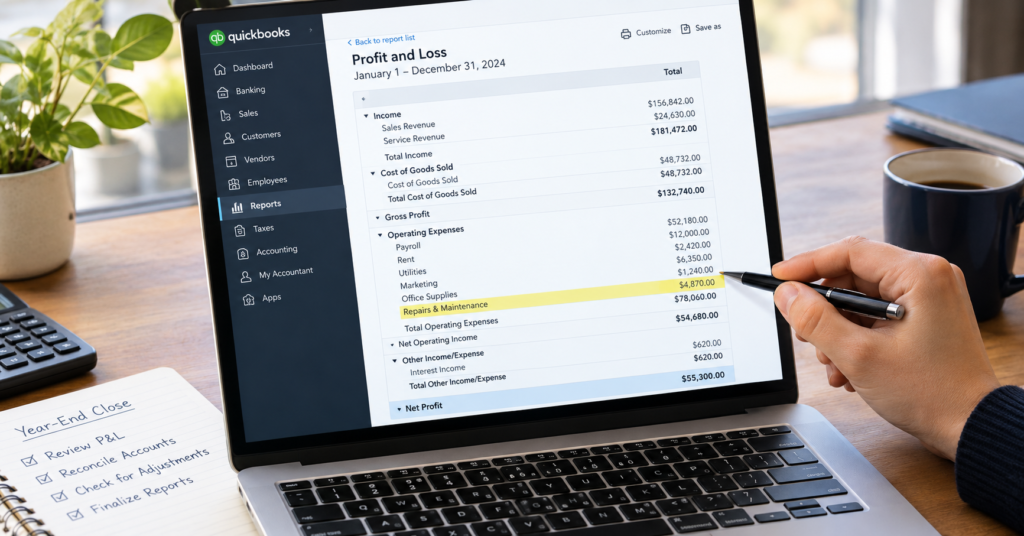
Generate a profit and loss statement and a balance sheet for the full year. Review them line by line. Does revenue look right based on what you invoiced and collected? Do expenses match your spending patterns? Does the balance sheet balance? These reports are what your CPA uses to prepare your return, so catching errors now avoids amendments later.
9. Organize supporting documents
Gather and organize all receipts, bank statements, loan documents, contracts, and insurance policies for the year. Store digital copies in a cloud drive organized by month or category. The IRS requires you to keep records that support every item on your return, typically for three years. New Jersey can look back four years on sales tax. Having everything accessible means a faster, less expensive tax preparation process.
10. Deliver year-end package to your CPA
Once your books are reconciled and your reports are clean, package everything your CPA needs: the year-end profit and loss, balance sheet, general ledger, 1099 data, payroll summaries, and any supporting schedules. The earlier you deliver this package, the earlier your return gets filed, and the sooner you know whether you owe or are getting a refund.
How does automation help with year-end bookkeeping?
Automation does not eliminate the year-end close, but it makes each step faster and less error-prone. When your bank feeds, invoicing, and payroll run through your bookkeeping software all year, most of the data is already recorded by the time October arrives. Your year-end work shifts from entering transactions to reviewing and verifying what the system captured.
What should be automated year-round
- Bank and credit card feeds. Connect every business account to QuickBooks Online or Xero so transactions import daily and categorize automatically based on rules you set.
- Recurring invoices. If you bill the same clients each month, schedule recurring invoices so they go out on time without manual effort.
- Receipt capture. Use a mobile app to photograph receipts at the point of purchase. Both QuickBooks and Xero match the image to the transaction automatically.
- Payroll processing. Automated payroll calculates NJ withholding, unemployment, disability, and family leave contributions, generates pay stubs, and files quarterly returns.
- Sales tax tracking. Configure your point of sale or invoicing system to apply New Jersey’s 6.625% rate on taxable items and track what you owe each quarter.
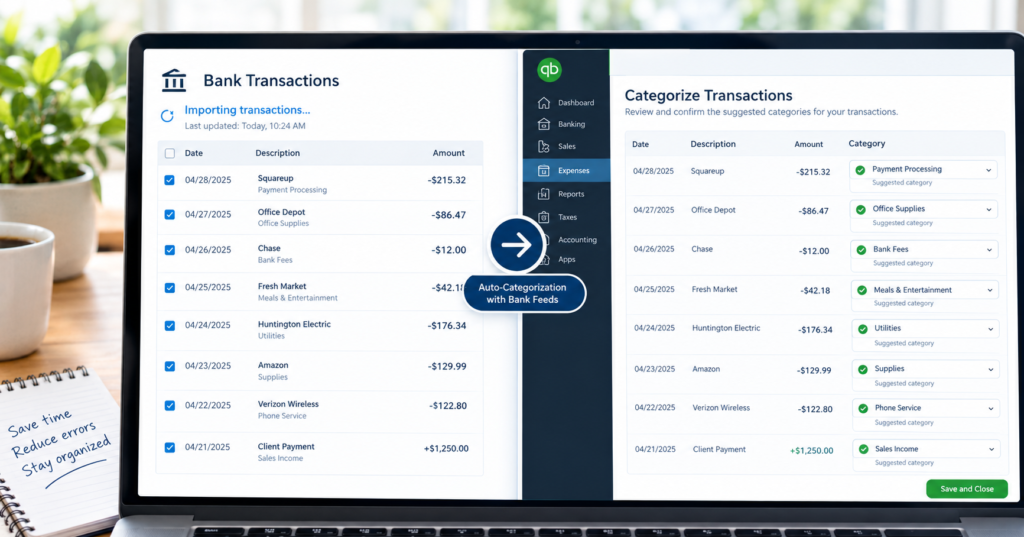
The businesses we onboard with the cleanest year-end closes are the ones that automated these five areas early in the year. When the system records and categorizes transactions daily, the year-end review is a verification exercise, not a data entry marathon. If you have not set up automation yet, doing it now still saves time on next year’s close.
What mistakes should you avoid at year-end?
The most common year-end bookkeeping mistakes are not complicated. They come from putting things off, mixing up categories, or forgetting about obligations that only surface once a year.
- Skipping reconciliation. If you have not reconciled your accounts all year, doing it in December means sorting through twelve months of transactions at once. Start monthly reconciliation now, even if you are catching up.
- Mixing personal and business expenses. Every personal charge on a business card or business expense paid from a personal account creates extra work and weakens your liability protection as an LLC or corporation.
- Waiting until January for W-9 collection. Contractors are harder to reach after the holidays. Collect W-9s now while you are still in regular contact.
- Ignoring zero-balance sales tax returns. New Jersey penalizes unfiled returns even when nothing is owed. Check that all four quarterly Form ST-50 filings were submitted.
- Not backing up your data. Cloud-based platforms like QuickBooks Online store your data automatically, but you should also keep separate cloud copies of receipts, statements, and contracts. Hardware failures, account lockouts, and software migrations happen.
Each of these mistakes adds hours to your year-end close and increases the chance of errors on your tax return. The earlier you catch them, the less they cost to fix.
| Next step: Behind on your bookkeeping and not sure where to start? Schedule a consultation with Blaize Accounting Services. We will assess where your books stand and build a plan to get them year-end ready. |
Frequently asked questions about year-end bookkeeping
When is the deadline to file 1099-NEC forms?
1099-NEC forms for the 2026 tax year are due to both the recipient and the IRS by January 31, 2027. There is no automatic extension for this deadline. Late filings can result in penalties starting at $60 per form.
What is the new 1099 reporting threshold for 2026?
The One Big Beautiful Bill Act raised the 1099-NEC reporting threshold from $600 to $2,000 for payments made in the 2026 tax year. If you paid an independent contractor $2,000 or more during 2026, you must file a 1099-NEC. The $600 threshold still applies to payments made in 2025.
How far back can the IRS audit my records?
The IRS generally has three years from the date you file your return to initiate an audit. If the IRS identifies a substantial understatement of income (more than 25%), the window extends to six years. New Jersey can look back four years on sales tax records. Keep all supporting documents for at least four years to cover both federal and state requirements.
Do I need to file a NJ sales tax return if I collected nothing?
Yes. If your business is registered to collect New Jersey sales tax, you must file Form ST-50 every quarter, even when you collected zero tax. Failing to file a zero return can trigger penalties from the New Jersey Division of Taxation.
What should I give my CPA at year-end?
Your CPA needs a year-end profit and loss statement, a balance sheet, a general ledger or trial balance, payroll summaries including W-2 and W-3 data, 1099 information for contractors, bank and credit card statements for December, loan statements showing interest paid, and any supporting schedules for depreciation or major asset purchases.
Can a bookkeeper help if my books are several months behind?
Yes. A professional bookkeeper can perform a cleanup that reconciles all accounts, recategorizes transactions, and corrects errors to bring your books current. The further behind you are, the more time-intensive the cleanup, so starting sooner saves money and reduces stress heading into tax season.
What is the difference between bookkeeping and year-end accounting?
Bookkeeping is the ongoing recording and categorizing of transactions throughout the year. Year-end accounting takes those records and uses them to prepare financial statements, calculate tax obligations, and file returns. Clean bookkeeping year-round makes the year-end accounting process faster, more accurate, and less expensive.
| Work with Blaize Accounting Services: Blaize Accounting Services, an accounting firm in Bergen County, New Jersey, helps small business owners and high-net-worth individuals get their bookkeeping, payroll, and tax preparation on solid ground. If your year-end close feels bigger than you can handle alone, contact us today to find out how we can help. |
ABOUT THE AUTHOR
Tania Blaize is the founder of Blaize Accounting Services, a Northern New Jersey accounting firm based in Bergenfield. With over 20 years of experience serving small business owners and high-net-worth individuals across Bergen, Passaic, Essex, Morris, and Hudson counties, Tania specializes in bookkeeping, QuickBooks Online setup and cleanup, tax planning, and payroll compliance
