
filed in
What Does Bookkeeping Cost in Bergen County? A Pricing Guide for Small Businesses

Bookkeeping for a small business in Bergen County typically costs $200 to $2,500 a month, depending on transaction volume, whether payroll is included, and whether a CPA reviews the work. Freelance bookkeepers usually charge $25 to $100 an hour. Firms that bill a flat monthly fee tend to be more predictable and, over a year, often cheaper.
Every firm structures its pricing differently, which makes real comparison hard. These are general market ranges pulled from industry data, not any one firm’s rate card. We scope every engagement around a business’s actual transaction volume and complexity rather than slotting clients into a fixed tier, and most reputable firms work the same way. Here’s what actually drives the number up or down, and the costs that show up after you’ve signed.
What determines what you’ll pay?
Five factors set your bookkeeping price: how many transactions you generate each month, whether you run payroll, how many bank and credit card accounts need reconciling, whether your industry adds complexity like inventory or multiple locations, and whether your books need catch-up work before regular service can start. None of these factors are things a provider can guess accurately from a phone call. They’re things a provider needs to actually look at, which is why a real quote almost always follows a review of your books, not a generic conversation about your industry.
- Transaction volume — the single biggest driver. More sales, expenses, and invoices mean more time per month.
- Payroll — coordinating payroll adds a recurring task most firms price separately.
- Number of accounts — every bank account, credit card, and loan adds a reconciliation.
- Industry complexity — inventory, multiple locations, or multi-state sales tax all raise the price.
- Backlog — books that are months or years behind require a one-time cleanup before monthly service begins.
Of these five, transaction volume and backlog are the two owners most consistently underestimate when they’re pricing out providers on their own. It’s easy to picture your business as ‘not that complicated.’ But a business processing 300 transactions a month takes meaningfully longer to keep accurate than one processing 50, regardless of revenue, and a business that hasn’t looked closely at its bank feed in eight months almost never turns out to be as caught-up as the owner assumed.
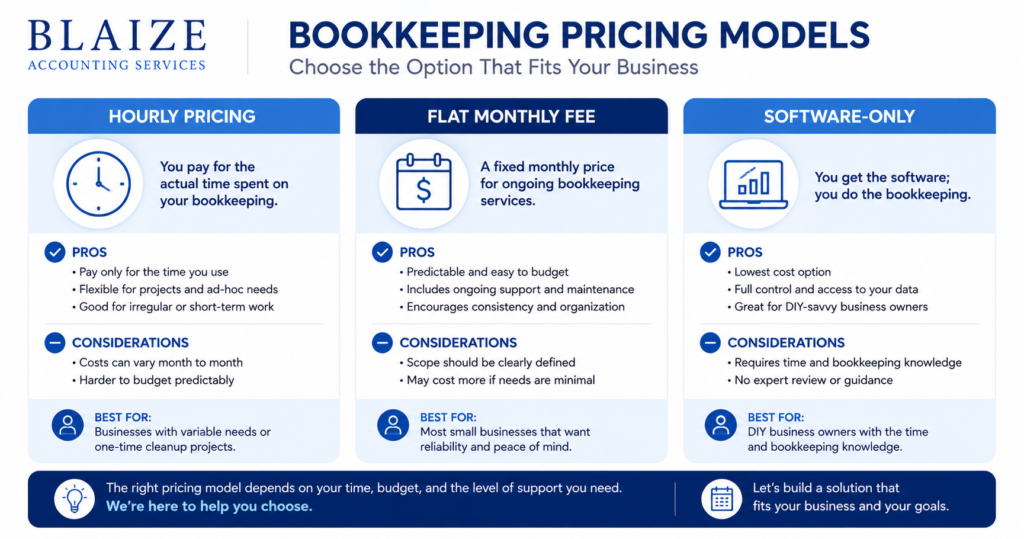
Hourly, flat monthly fee, or software-only: which pricing model fits?
A flat monthly fee is the most predictable option because your cost doesn’t change month to month. Hourly billing can work for very light, occasional needs but makes budgeting harder and can misalign incentives.
Hourly billing has a structural quirk worth understanding before you agree to it. The provider earns more when the work takes longer, which isn’t necessarily bad faith, but it does mean neither side has a strong incentive to work efficiently. Flat-fee pricing flips that the firm is incentivized to build efficient processes, because their margin depends on doing the work well within the agreed scope, not on running the clock.
| Model | How it works | Best for |
|---|---|---|
| Hourly | $25–$100/hour, billed for time worked | Very low-volume or occasional cleanup work |
| Flat monthly fee | Fixed price based on your business profile | Most small businesses — predictable budgeting |
| Software subscription only | You do the bookkeeping yourself in QuickBooks or Xero | Owners with time and comfort doing it in-house |
Typical monthly cost by business size
| Definition: Outsourced bookkeeping is a service where a third-party bookkeeper or firm manages a business’s financial records for a recurring fee, instead of the business hiring and training an in-house employee to do the same work. |
| Business profile | Typical monthly range |
|---|---|
| Solo owner or side business, low transaction volume | $200 – $500 |
| Small business, standard complexity, no payroll | $500 – $1,200 |
| Small business with payroll and moderate volume | $1,200 – $1,800 |
| Growing business, multiple accounts or locations | $1,800 – $2,500+ |
For context, a full-time in-house bookkeeper costs a business roughly $45,000 to $55,000 a year in salary alone, before benefits. Which is why outsourcing is usually the cheaper option below a certain size. That comparison also leaves out the time a business owner spends hiring, training, and covering the role during vacations, sick days, or turnover, none of which shows up on a salary line, but all of which is real cost.
What drives cost in real engagements
Published ranges only tell part of the story. Two composite examples, drawn from patterns we see often and with identifying details changed, show why the same business type can land at very different price points.
The seasonal retailer who outgrew a flat low-volume quote
A specialty retail business came to us assuming their bookkeeping would price like any other small shop, low and flat, year-round. What their previous provider hadn’t accounted for was the seasonal spike: transaction volume in November and December ran roughly four to five times the rest of the year, with a surge of returns, gift card redemptions, and short-term seasonal payroll on top of it. The original flat quote didn’t hold past the first holiday season, and the provider had to rescope the engagement mid-contract, which created friction neither side wanted. The fix going forward was building the seasonal swing into the scope from day one, instead of pricing off an average month.
The firm that didn’t know how far behind it really was
A professional services firm believed their books were roughly current when they reached out, based on what their outgoing bookkeeper had told them. Once we reviewed the file, several bank accounts hadn’t been reconciled in over a year, and a handful of vendor bills had been double-entered. That kind of backlog is common and not a reflection on the business, but it does mean a cleanup project has to happen before regular monthly service can start, priced separately from the ongoing engagement. It’s exactly why we always review a business’s actual books before quoting anything, rather than pricing off a business’s self-reported transaction volume.
Why every legitimate bookkeeping engagement gets scoped individually
A fixed-tier pricing table is easy to publish but rarely reflects what a real engagement costs, because two businesses with identical revenue can have wildly different bookkeeping needs. A single-location service business with one bank account and no payroll is a different job than a multi-location retailer with inventory, sales tax across several jurisdictions, and weekly payroll even if both do $1.5 million in annual revenue.
That’s why, instead of publishing a rate card, most experienced firms, ours included, start with a review of your actual books, transaction volume, and complexity, then build a monthly price around what your business specifically needs. It takes longer than reading off a price sheet, but it means you’re not overpaying for services you don’t need, or underpaying in a way that surfaces as scope creep six months in.
What costs show up after you sign?
The advertised monthly rate rarely includes everything. Ask specifically about catch-up fees, software subscription costs, and payroll add-ons before you commit.
- Cleanup or catch-up fees — a one-time charge to bring behind-schedule books current before monthly service starts; the more months of unreconciled activity, the larger this project tends to run. Ask any firm to review your actual books before quoting a number, rather than accepting a flat estimate sight unseen.
- Software subscriptions — QuickBooks Online or Xero fees, whether billed to you directly or built into the bookkeeping fee.
- Payroll processing — often $80 to $200 per pay run if not bundled into the base price.
- Sales tax filing — some firms include it, others bill it separately per filing.
How to get an accurate quote instead of a guess
The fastest way to get a real number, instead of a wide range, is to bring the specifics instead of waiting to be asked for them.
- Pull your last 3 months of bank and credit card statements so a provider can see actual transaction volume, not your estimate of it.
- Say whether you run payroll and how many employees, since payroll coordination is priced separately by most firms.
- Mention any known backlog — even a rough sense of ‘we’re behind since spring’ helps a firm scope the cleanup accurately.
- List every account that needs reconciling — bank accounts, credit cards, loans, and any merchant processor accounts like Stripe or Square.
- Ask for the quote in writing, itemized by service, so you can compare it apples-to-apples against another provider’s quote.
Is a cheaper price always a worse deal?
Not necessarily, but a price far below the ranges above usually means fewer services included, less experienced staff, or no CPA oversight — ask exactly what’s covered before assuming you found a bargain.
The clearest way to compare two quotes isn’t the monthly number itself; it’s what each provider includes for that number. A lower quote that only covers categorization and leaves reconciliation to you isn’t actually cheaper than a higher quote that includes full reconciliation, categorization, and a reviewed financial statement; it’s just a smaller scope of work. Ask each provider to itemize exactly what’s in scope before comparing the totals side by side.
| Key takeaway: Compare scope before you compare price. Two quotes with very different numbers often reflect two very different lists of what’s actually included, not two different opinions about what the same work is worth. |
| Next step: Want a real number for your business instead of a range? Book a consultation and we’ll scope it based on your actual transaction volume. |
Frequently asked questions
How much does a bookkeeper cost per hour?
Freelance bookkeepers typically charge $25 to $100 an hour, depending on experience and location. Most small businesses outgrow hourly billing once transaction volume becomes regular, since the unpredictability makes budgeting harder.
Is outsourced bookkeeping cheaper than hiring in-house?
Usually, for businesses under roughly 15 to 20 employees. An in-house bookkeeper’s salary alone often runs $45,000 to $55,000 a year, before benefits and software costs. That’s before accounting for the time spent hiring, training, and covering for absences.
Why do bookkeeping cleanup fees cost so much?
Untangling a year of miscategorized transactions and unreconciled accounts takes longer than keeping clean books month to month, which is why cleanup is billed as a separate, one-time project rather than folded into the ongoing rate.
Does bookkeeping cost more in Bergen County than the national average?
Bergen County pricing generally falls within national ranges for the Northeast, $300 to $2,500+ a month for most small businesses. Firms with CPA oversight tend to price toward the higher end of that range.
What’s typically included in a monthly bookkeeping fee?
Bank and credit card reconciliation, transaction categorization, and a monthly profit and loss statement are standard. Payroll coordination and sales tax filing are often priced separately, so confirm what’s bundled before comparing quotes.
Why won’t a bookkeeping firm just give me a flat price over the phone?
A responsible firm wants to see your actual transaction volume and the state of your existing books before quoting, because pricing off a guess tends to lead to renegotiation later. Either the business overpays for services it doesn’t need, or the firm underprices and has to revisit the number.
Can my bookkeeping cost change after I sign on?
Yes, if your transaction volume, payroll headcount, or complexity changes meaningfully, a seasonal sales spike, or a new location, for example. A good provider will flag that shift and discuss the adjustment with you rather than silently changing the invoice.
| Work with Blaize Accounting Services: Blaize Accounting Services prices bookkeeping around what your business actually needs, not a one-size tier. Schedule a call for a straight number. |
ABOUT THE AUTHOR
Tania Blaize is the founder of Blaize Accounting Services, a Bergen County firm providing bookkeeping, QuickBooks and Xero support, and tax planning for small businesses and high-net-worth individuals across Northern New Jersey. She has more than 20 years of experience helping business owners get their books under control.
This article is general information, not tax or accounting advice for your specific situation. Pricing ranges are approximate and change with market conditions — consult a qualified professional for a quote based on your own facts.
