
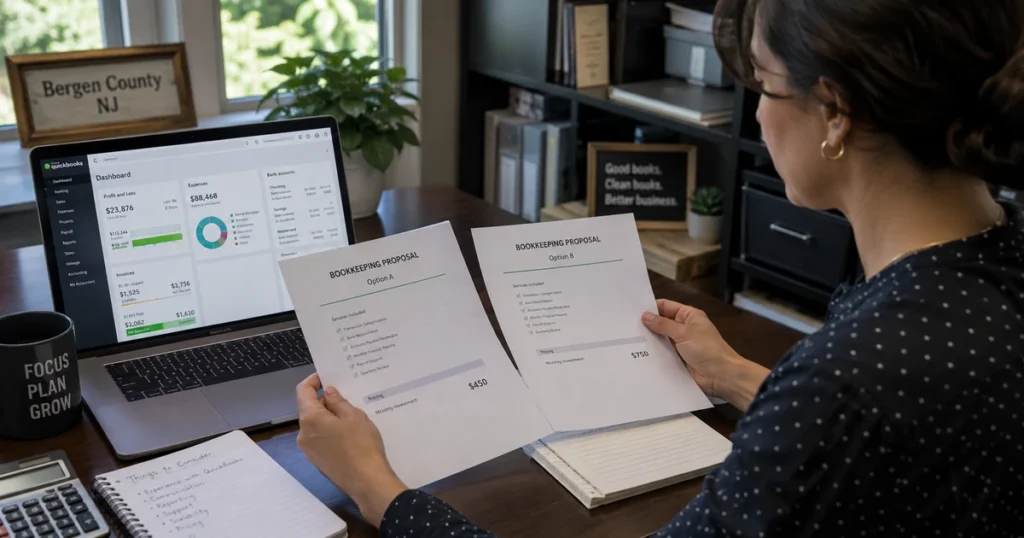
The right bookkeeping service for a Bergen County business uses cloud software you can log into anytime, assigns you a dedicated bookkeeper who understands New Jersey sales tax and payroll rules, and delivers closed financials within 10 to 15 days of month-end. Everything past that is preference, not requirement.
Bergen County has one of the highest concentrations of small businesses in New Jersey, and every one of them eventually asks the same question: do I hire in-house, go it alone in QuickBooks, or bring in a bookkeeping service? If you’ve decided to outsource, the harder question is which firm actually fits your business. Here’s how to evaluate one before you sign anything.
What should a bookkeeping service actually do for your business?
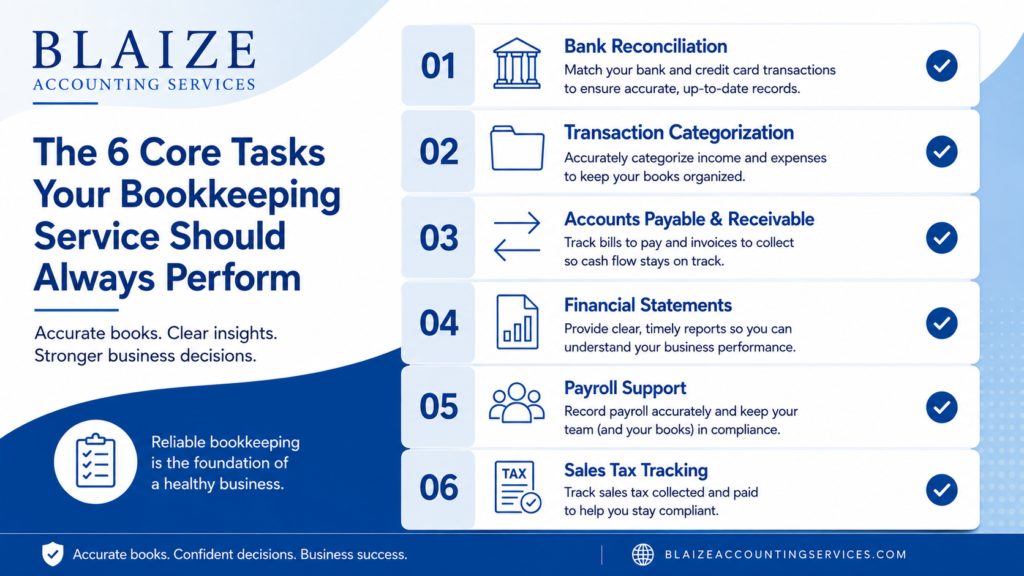
A bookkeeping service should record every transaction, reconcile your bank and credit card accounts monthly, keep your books ready for tax time, and hand you financial statements you can actually use to make decisions — not just a login you never check. That last part is where a lot of business owners get shortchanged: a service can technically deliver every task on this list and still leave you no better informed than before, if nobody ever walks you through what the numbers mean for your business specifically.
| Definition: A bookkeeping service is a business that manages a company’s day-to-day financial records — recording transactions, reconciling accounts, tracking accounts payable and receivable, and producing monthly financial statements — so the business owner has accurate books without doing the data entry themselves. |
Core tasks any service should cover
- Bank and credit card reconciliation — every account matched to the statement, every month.
- Transaction categorization — coded the first time correctly, not fixed in a year-end scramble.
- Accounts payable and receivable tracking — who you owe, who owes you, and when.
- Monthly financial statements — a profit and loss and balance sheet you receive on a set schedule.
- Payroll support — coordination with your payroll provider to ensure wages and taxes are recorded correctly.
- Sales tax tracking — critical in New Jersey, where the state sales tax rate is 6.625%, and exemptions vary by product and service type.
What credentials and experience should you look for?
Look for QuickBooks Online or Xero ProAdvisor certification, at least a few years of direct client work, and — ideally — CPA oversight on the account, even if the day-to-day work is done by a bookkeeper. The AICPA’s guidance on choosing a financial professional is a useful outside check on what credentials actually signal.
Certification alone doesn’t guarantee quality, but its absence is a real gap: it means nobody has verified the person understands the software they’re managing your records in. Ask how long the firm has been in business and whether they work with businesses like yours — a restaurant’s books look nothing like a professional services firm’s books. A restaurant needs someone comfortable with daily sales batches, tip reporting, and food cost percentages; a professional services firm needs someone comfortable with retainers, work-in-progress, and owner draws. The same bookkeeper can usually handle both, but ask them to walk you through how they’d set up your chart of accounts specifically, not generically — a vague answer here is often the clearest early signal of fit.
- Software certification — QuickBooks Online ProAdvisor or Xero Certified Advisor status.
- Years in practice — three or more years reduces the odds you’re a firm’s first real client.
- Industry experience — ask for a client example in your industry, not just a general reference.
- CPA involvement — a bookkeeping-only firm can be excellent, but knowing whether a CPA reviews the work (or hands off cleanly to your tax preparer) matters at year-end.
What this looks like in practice
The checklist above is easier to follow with real examples behind it — here are two composite cases, drawn from patterns we see often in Bergen County, with identifying details changed.
The contractor whose bookkeeper stopped reconciling
A general contractor came to us mid-year after applying for equipment financing and getting turned down over inconsistent financials. His previous bookkeeper — a solo freelancer he’d found through a referral — had stopped reconciling his business credit card roughly eight months earlier. Nobody caught it because he never logged into QuickBooks himself; he just assumed the monthly report he skimmed was accurate.
Once we opened the file, the credit card account showed a balance that hadn’t matched the actual statement in over half a year, which meant thousands of dollars in job-related expenses were sitting uncategorized and his profit and loss statement was overstating income by a wide margin. The fix took a multi-week cleanup project before we could start monthly service. The lesson we took from it, and now tell every prospective client: ask your bookkeeper how they’d know if a reconciliation broke, and how they’d tell you.
The practice that hired on price alone
A small professional services practice chose a bookkeeping service based almost entirely on being the lowest quote they received. The person doing the work wasn’t certified in the software the practice used, and over several months, owner draws were repeatedly miscategorized as business expenses. That inflated the practice’s apparent expense load and understated real profitability — which led the owner to delay a hiring decision she could actually have afforded to make months earlier.
Nothing about that provider was dishonest. They were simply undertrained for the software and the account, and nobody had asked about certification or software fit during the hiring process. It’s exactly why credentials and industry experience matter more than the sticker price on a proposal.
Common mistakes business owners make when evaluating a bookkeeping service
Most bad bookkeeping relationships trace back to one of a handful of avoidable mistakes made during the hiring process, not to bad luck. In our experience, the businesses that end up frustrated with a bookkeeping service almost never got there because the provider was incompetent across the board — it’s usually one specific gap that went unquestioned at the start.
- Choosing on price alone — the cheapest quote is often cheap because it includes less oversight, not because the provider is more efficient.
- Not confirming software fit — a provider who works in a platform you don’t use, or won’t use the one you’re already on, creates friction from day one.
- Skipping the reference check — ask for a client in your industry, and actually call them.
- Not defining a point of contact — ‘our team will handle it’ can mean nobody owns your account specifically.
- Assuming any provider understands New Jersey rules — sales tax nexus, CBT-100S filings, and state payroll withholding all have state-specific quirks a generalist national provider may not know well.
Should you choose a local Bergen County firm or a fully virtual service?
Either can work well; the deciding factor is how you want to communicate, not where the bookkeeper sits. A local Bergen County firm offers in-person meetings and familiarity with New Jersey-specific issues like CBT-100S filings and local business registration; a virtual service often costs less and gives you faster response times through chat or email.
What matters more than location is responsiveness: how quickly does the firm answer a question mid-month, and can you get someone on the phone before a deadline, not just after one’s been missed.
We’ve worked with a retail business owner who’d previously used a large national virtual bookkeeping platform and found the opposite problem: response times were fine on paper, but she was routed to a different support agent almost every time she wrote in, and had to re-explain her business each time. She switched to a Bergen County-based service specifically to get one consistent point of contact who already knew her seasonal sales pattern and her vendor list. That’s the trade-off worth weighing — not local versus virtual in the abstract, but continuity of who actually handles your account.
How much should a bookkeeping service cost?
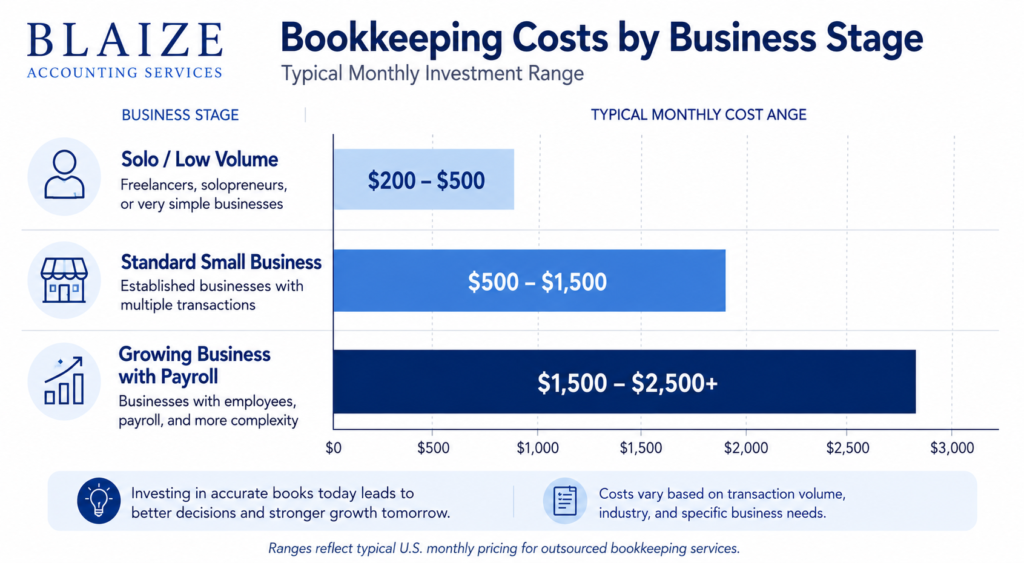
Small businesses typically pay between $300 and $2,500 a month for outsourced bookkeeping, depending on transaction volume, whether payroll is included, and whether the books need catch-up work before regular service starts. These are general market ranges, not a fixed rate card; every legitimate firm, including ours, scopes pricing around your actual transaction volume and complexity rather than slotting you into a generic tier.
| Business stage | Typical monthly range | What’s usually included |
|---|---|---|
| Solo / very low volume | $200 – $500 | Basic categorization, monthly reconciliation |
| Small business, standard | $500 – $1,500 | Full reconciliation, AP/AR, monthly financials |
| Growing business with payroll | $1,500 – $2,500+ | Above plus payroll coordination, sales tax filing |
Six questions to ask before you sign
- What software do you use, and can I keep ownership of the account if we part ways?
- How many days after month-end will I receive my financials?
- Who’s my point of contact, and what’s your typical response time?
- Is there a setup or catch-up fee if my books are behind?
- Do you handle sales tax and payroll coordination, or only the core bookkeeping?
- What happens at tax time — do you hand off to my CPA, or is that included?
| Next step: Not sure which model fits your business? Book a consultation, and we’ll walk through your books together. |
Frequently asked questions
What’s the difference between a bookkeeper and an accountant?
A bookkeeper records daily transactions and reconciles accounts; an accountant analyzes those records, prepares tax filings, and advises on strategy. Most small businesses need both, often through the same firm. See our full breakdown of the difference between a bookkeeper and an accountant.
Should I choose a local Bergen County bookkeeper or a virtual service?
Either works well. Choose local if in-person meetings matter to you; choose virtual if faster response time and lower cost matter more. Confirm New Jersey tax familiarity either way, since sales tax nexus and state payroll rules trip up generalist national providers more often than local ones.
What software should my bookkeeping service use?
QuickBooks Online and Xero are the two most common platforms for small businesses. Whichever your bookkeeper uses, confirm you retain ownership and admin access to the account, so you’re never locked out if you decide to switch providers later.
How often should I receive financial reports from my bookkeeper?
Monthly, delivered within 10 to 15 days of month-end, is the standard for an actively managed small business. Anything slower makes the reports less useful for decisions, since you’re reacting to numbers that are already six or eight weeks stale.
What’s a red flag when interviewing a bookkeeping service?
Vague answers about turnaround time, reluctance to name the software they use, or an unwillingness to explain how catch-up and cleanup fees work are all signs to keep looking.
How long does it take to switch bookkeeping services?
A straightforward switch of books that are current and reconciled usually takes one to two weeks to transfer software access and get oriented. If the books are behind, expect a separate catch-up project before regular monthly service begins.
What happens to my historical bookkeeping data when I switch providers?
If you own your QuickBooks Online or Xero subscription, your historical data stays with you and simply gets a new user added. If your previous provider owned the account, ask them to export your data or transfer ownership before you cancel.
| Work with Blaize Accounting Services: Blaize Accounting Services provides bookkeeping for small businesses and high-net-worth individuals across Bergen County and Northern New Jersey. Schedule a call to see whether we’re the right fit. |
ABOUT THE AUTHOR
Tania Blaize is the founder of Blaize Accounting Services, a Bergen County firm providing bookkeeping, QuickBooks and Xero support, and tax planning for small businesses and high-net-worth individuals across Northern New Jersey. She has more than 20 years of experience helping business owners get their books under control.
This article is general information, not tax or accounting advice for your specific situation. Consult a qualified professional about your own facts before making a decision.
