filed in
Bookkeeping for Distributors in New Jersey: What Your Business Actually Needs
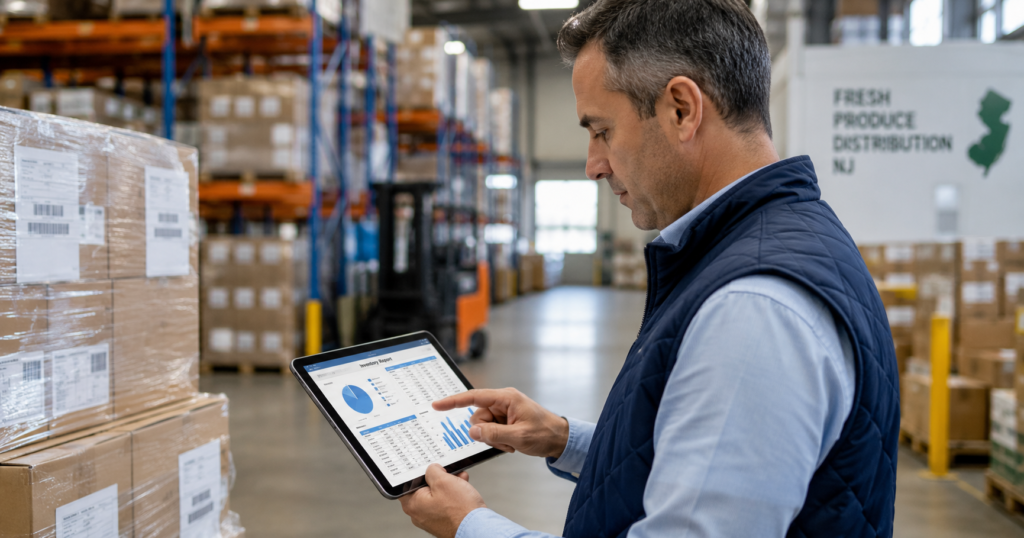
Bookkeeping for a distribution business in New Jersey is not the same as bookkeeping for a law firm or a landscaping company. You are tracking cost of goods sold across hundreds or thousands of SKUs, reconciling purchase orders against vendor invoices, managing sales tax on shipments to multiple states, and trying to get inventory counts that actually match what is on your shelves. If those numbers are off, your margins are off, and you will not know it until tax time.
At Blaize Accounting Services, we work with distributors across Bergen County and Northern New Jersey. We have helped family-run operations move from Excel spreadsheets to QuickBooks, migrated companies off QuickBooks Desktop before the 2026 sunset, integrated ERP and POS systems with their accounting software, and coached owners and family members on how to manage the books themselves. This post covers the bookkeeping challenges distributors face, the services that solve them, and how to tell whether your current setup is costing you money.
Why is distributor bookkeeping more complex than other industries?
Distribution businesses move physical product through a supply chain, and every step, including purchasing, warehousing, shipping, and invoicing, creates a financial transaction that needs to be recorded accurately. Most service businesses have a handful of expense categories and a simple revenue stream. Distributors have layered complexity that compounds when the books are not set up correctly.
| Definition: Distributor bookkeeping is the process of recording, categorizing, and reconciling financial transactions for a wholesale or distribution business, including inventory purchases, cost of goods sold, vendor payments, customer invoicing, sales tax collection across multiple jurisdictions, and freight or shipping costs. |
Here is what makes it different from general small business bookkeeping:
- Inventory is the largest asset on your balance sheet. If your books do not track what you bought, what you sold, and what is still in the warehouse, your financial statements are unreliable. A distributor doing $3 million in annual revenue might carry $400,000 to $700,000 in inventory at any given time. An error rate of even 5% means $20,000 to $35,000 in misstated assets.
- Cost of goods sold drives your gross margin. COGS is not just what you paid for the product. It includes freight-in, customs duties if you import, and sometimes warehouse labor allocated to receiving. If COGS is categorized wrong, your gross margin looks better or worse than it actually is, and you make pricing decisions based on bad data.
- Multi-state sales tax compliance is unavoidable. If you ship product to customers in multiple states, you likely have sales tax nexus in those states. New Jersey alone has a 6.625% sales tax rate, and if you are also shipping to New York, Pennsylvania, or Connecticut, each state has its own rules for what is taxable, what is exempt, and when you need to remit.
- Vendor terms and payment timing affect cash flow. Distributors typically work on net-30 or net-60 terms with their suppliers while extending similar terms to their customers. Recording accounts payable and accounts receivable accurately is not optional. It is how you know whether you can cover next week’s purchase order.
- Family involvement complicates the books. Many distributors in Bergen County are family-run businesses. Multiple family members may have access to bank accounts, place orders, or handle cash, and without a clear bookkeeping system, transactions get missed or duplicated.
What bookkeeping services do NJ distributors need?
The specific services depend on where your business is in its growth, what software you are using, and whether you have in-house staff handling the day-to-day. But most distributors we work with in Bergen County need some combination of the following.
Outsourced bookkeeping
Outsourced bookkeeping means a professional firm handles your transaction categorization, bank and credit card reconciliations, accounts payable and receivable tracking, and monthly financial statement preparation. For distributors, this also includes inventory-related entries and COGS tracking. The benefit is accuracy and consistency. You get clean books every month without hiring a full-time employee, and your accountant or CPA has reliable numbers to work from at tax time.
We provide outsourced bookkeeping for distribution businesses throughout Northern New Jersey, handling everything from weekly transaction coding to monthly balance sheet reviews.
QuickBooks Desktop to QuickBooks Online migration
Intuit ended support for QuickBooks Desktop 2023 versions in May 2026, and the 2024 release is the final Desktop version they plan to ship. If your distribution business is still running on Desktop, you are losing access to payroll updates, bank feeds, and security patches. The move to QuickBooks Online is not just about staying current. It gives your team real-time access from anywhere, which matters when you have people in the warehouse, on the road, and in the office.
We have migrated several local distributors from Desktop to Online. The process includes cleaning up your chart of accounts, mapping inventory items, verifying that customer and vendor records transfer correctly, and testing integrations with any third-party apps you rely on. A migration done wrong can result in duplicated transactions, missing historical data, or a chart of accounts that does not match your old reports. It is not a project to hand off to someone unfamiliar with distribution accounting.
ERP and POS software integration
Many distributors use an enterprise resource planning (ERP) system to manage inventory, purchasing, and order fulfillment, and a point-of-sale (POS) system if they have a showroom or retail counter. These systems generate financial data, including sales, returns, cost adjustments, and inventory movements, that needs to flow into your accounting software accurately.
We help distributors connect their ERP and POS platforms to QuickBooks Online so that data syncs automatically and does not require manual re-entry. This eliminates the double-entry errors that happen when someone is keying numbers from one system into another, and it gives you a single source of truth for your financials.
QuickBooks coaching for owners and family members
In a family-run distribution business, the owner may handle purchasing, a spouse or sibling manages invoicing, and an adult child runs the warehouse. Each of them touches the financial side of the business, and if they are not using QuickBooks correctly or not using it at all, the books break down.
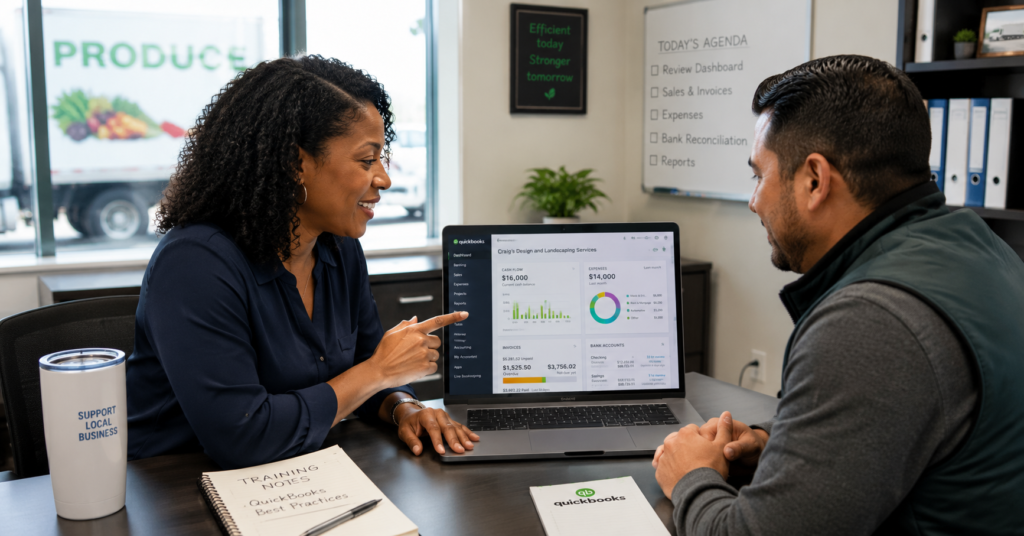
We provide one-on-one QuickBooks coaching for family members and trusted employees who are responsible for day-to-day financial tasks. The goal is not to turn everyone into an accountant. It is to make sure that when someone enters a bill, records a payment, or creates an invoice, they do it the right way so the data is clean when it reaches the bookkeeper.
How a $5 million distributor moved from Excel to QuickBooks
One of the most rewarding engagements we have had at Blaize Accounting Services involved a family-run distribution company in Northern New Jersey that was doing over $2 million in annual revenue. They were tracking every dollar of it in Excel spreadsheets.
The business had grown steadily over the years, and the spreadsheets that worked when revenue was $500,000 were buckling under the weight of thousands of monthly transactions. The owners were spending hours each week entering checks in a check register and then trying to reconcile everything at the end of the month. Errors were common. Month-end close took days. And their accountant was getting incomplete data at tax time, which meant missed deductions and higher preparation fees.
We determined what QuickBooks software was best suited for their needs and designed a chart of accounts in QuickBooks that matched how their business actually operates. We imported historical data so they would not lose visibility into prior periods, and set up vendor and customer records.
Then we trained the family members who handle the bookkeeping. One of the owners learned how to review profit and loss statements and balance sheets inside QuickBooks instead of building them manually. The family member who managed purchasing learned how to enter bills and track vendor credits. The person handling invoicing learned how to create and send customer invoices and apply payments.
After implementation, their month-end close went from days to hours. Their accountant had clean, organized data for tax preparation. And the owners could pull up a real-time snapshot of their business, including revenue, expenses, cash position, and outstanding receivables, without reliance on a spreadsheet.
| Note: This is an anonymized composite based on our actual client experience. Specific details have been adjusted to protect client confidentiality. If you would like to discuss how a similar transition could work for your business, book a free discovery call. |
What should you look for in a bookkeeper for your distribution business?
Not every bookkeeper understands the financial structure of a distribution company. Before you hire someone, whether in-house or outsourced, make sure they can demonstrate experience with the following:
| Capability | Why it matters for distributors |
|---|---|
| Inventory accounting (perpetual or periodic) | Your largest current asset needs accurate tracking. A bookkeeper who only handles service businesses may not know how to record inventory purchases, adjustments, or shrinkage. |
| Cost of goods sold calculation | COGS directly affects your gross margin and your tax liability. Misclassified freight, duties, or warehouse costs distort the number. |
| Multi-state sales tax tracking | If you ship to customers outside New Jersey, you need someone who understands nexus rules and can set up tax codes correctly in your accounting software. |
| QuickBooks Online proficiency | QuickBooks Online is the most common platform for distributors in the $1M to $10M range. Your bookkeeper should know how to configure it for inventory, set up classes or locations, and run distribution-specific reports. |
| ERP and POS integration experience | If your business uses third-party software for order management or point-of-sale, your bookkeeper needs to understand how data flows between systems and how to reconcile discrepancies. |
| Family business communication | In a family-run company, the bookkeeper often works with multiple family members who have different levels of financial literacy. Patience and clear communication matter. |
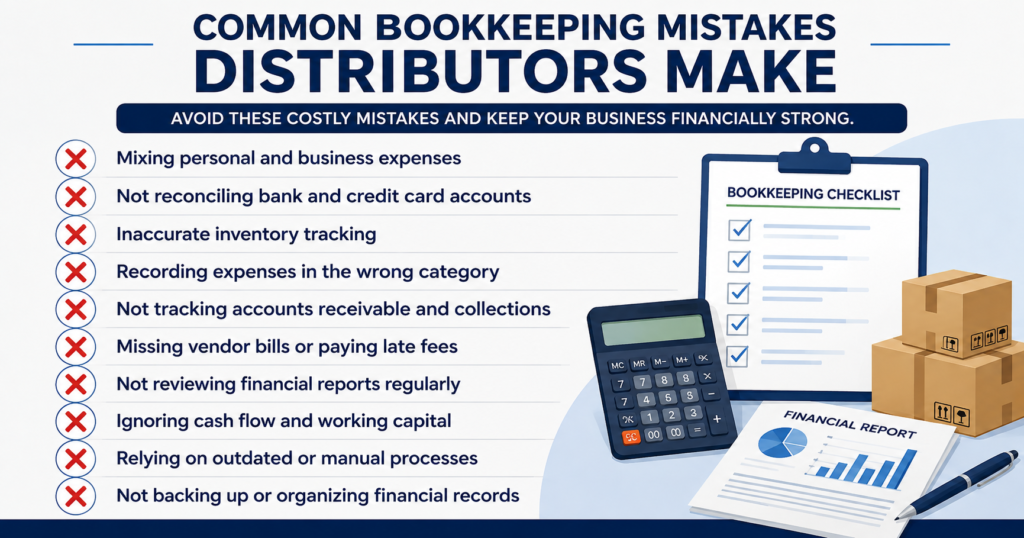
Common bookkeeping mistakes NJ distributors make
After more than 20 years of working with small businesses across Bergen County, we see the same mistakes in distribution companies over and over. Catching them early saves money and headaches at tax time.
- Mixing personal and business expenses. This is especially common in family-run businesses where the owner uses one credit card for everything. It makes your books unreliable and creates problems if you are ever audited.
- Not reconciling bank and credit card accounts monthly. If you are not reconciling every month, errors and fraudulent charges can go undetected for months. For a distributor processing hundreds of transactions, this is a major risk.
- Tracking inventory in a spreadsheet instead of your accounting software. When inventory lives outside QuickBooks, your balance sheet does not reflect your actual assets, and your COGS on the profit and loss statement is an estimate at best.
- Ignoring accounts receivable aging. Distributors often extend net-30 or net-60 terms to their customers. If you are not reviewing your aging report regularly, you may have $50,000 or more sitting in overdue invoices without realizing it.
- Classifying owner draws as expenses. Owner draws are not a business expense. They are a reduction in equity. Recording them as expenses inflates your costs and understates your profit, which can affect loan applications and business valuations.
- Skipping sales tax filings in states where you have nexus. With economic nexus thresholds, many NJ distributors owe sales tax in states they have never set foot in. The penalties for late or missed filings add up quickly.
Is your distribution business ready for tax season?
One of the best ways to find out whether your books are actually in order is to run through a quick self-assessment. We created a free checklist specifically for NJ distributors that walks you through the key areas your accountant will look at when preparing your return, including accounts receivable, accounts payable, inventory valuation, sales tax compliance, payroll records, and more.
If you can check every box, your books are in good shape. If you find gaps, you know exactly where to focus before your CPA starts asking questions.
| Free resource: Download the Are Your Books Tax-Ready? Free Checklist for NJ Distributors and find out where your books stand in about ten minutes. |
| Next step: Not sure your books are set up correctly for your distribution business? Book a free discovery call with Blaize Accounting Services, and we will review your current setup. |
Frequently asked questions about bookkeeping for distributors
How much does outsourced bookkeeping cost for a distribution business in NJ?
Pricing depends on your transaction volume, the number of bank and credit card accounts, whether you carry inventory in QuickBooks, and how many integrations need to be maintained. Most NJ distributors in the $1M to $10M revenue range can expect to pay between $800 and $2,500 per month for professional outsourced bookkeeping. Every engagement at Blaize Accounting Services is individually scoped based on your specific needs.
Can I still use QuickBooks Desktop for my distribution business?
Intuit ended support for QuickBooks Desktop 2023 in May 2026, and the 2024 version is the final release. You can still open your Desktop file locally, but you will not receive payroll updates, bank feed connections, or security patches. Most distributors should plan a migration to QuickBooks Online or evaluate a distribution-focused ERP if they have outgrown what QuickBooks can handle.
What is the best accounting software for wholesale distributors?
For most NJ distributors doing under $10 million in revenue, QuickBooks Online Advanced is the strongest option because of its inventory tracking, reporting, and integration ecosystem. Distributors with more complex needs, such as hundreds of thousands of SKUs, advanced warehouse management, or EDI requirements, may need a distribution-specific ERP like NetSuite, Acumatica, or Fishbowl alongside or instead of QuickBooks.
How do I integrate my POS system with QuickBooks?
Most modern POS systems offer a direct integration or sync app for QuickBooks Online. The setup involves mapping your POS sales categories to QuickBooks income accounts, configuring how inventory adjustments flow, and testing that daily sales summaries post correctly. We help distributors set up and verify these integrations so the data is accurate from day one.
Should I train my family members to use QuickBooks or outsource everything?
A combination usually works best. Outsource the reconciliations, financial statements, and complex adjustments to a professional. Train family members to handle the daily tasks they already touch, such as entering bills, creating invoices, and recording payments, so the data going into QuickBooks is clean. This gives you accuracy without having to hand off every small task.
| Work with Blaize Accounting Services. Blaize Accounting Services works with distributors and wholesale businesses across Bergen County and Northern New Jersey. Whether you need help migrating from QuickBooks Desktop, integrating your ERP or POS system, cleaning up years of backlogged books, or training your team on QuickBooks, we can help. Schedule a free consultation to get started. |
ABOUT THE AUTHOR
Tania Blaize is the founder of Blaize Accounting Services, a Bergen County firm providing bookkeeping, QuickBooks setup and support, and tax planning for small businesses and high-net-worth individuals across Northern New Jersey. With more than 20 years of experience, she has helped distributors, retailers, and service businesses get their financial operations under control.
This article is general information, not tax or legal advice for your specific situation. Consult a qualified professional about your own facts.
