
filed in
Exempt vs. Non-Exempt Employees: What Small Business Owners Need to Know in 2026
Exempt employees are paid a fixed salary of at least $684 a week and are excluded from overtime pay under the Fair Labor Standards Act. Non-exempt employees are entitled to overtime at 1.5 times their regular rate for any hours worked over 40 in a workweek, regardless of whether they’re paid hourly or salaried.
Getting this classification wrong is one of the most common and expensive payroll mistakes a small business can make. Here’s how the current federal threshold works, what the duties tests actually require, and what misclassification costs you if the DOL or an employee challenges it.
What’s the actual difference between exempt and non-exempt employees?
The difference comes down to two tests: how the employee is paid, and what they actually do. Both have to be met for an employee to be exempt from overtime.
| What is an exempt employee? An exempt employee is paid a fixed salary of at least $684 per week and performs executive, administrative, or professional duties as defined by the Fair Labor Standards Act, which excludes them from minimum wage and overtime protections. |
Non-exempt employees don’t meet both tests, so they’re entitled to at least minimum wage and overtime pay for hours over 40 in a workweek, regardless of job title or whether they’re paid a salary.
What salary makes an employee exempt in 2026?
The federal salary threshold for exempt status is $684 per week, or $35,568 per year, and New Jersey uses this same federal threshold rather than setting its own, unlike states such as New York or California.
| Threshold | 2026 amount |
|---|---|
| Federal EAP exemption (weekly) | $684 |
| Federal EAP exemption (annual) | $35,568 |
| Highly compensated employee (annual) | $107,432 |
| NJ minimum wage, most employers (hourly) | $15.92 |
This threshold was restored to its 2019 level after a 2024 Department of Labor rule that would have raised it substantially was struck down in federal court, so read the current DOL salary level guidance before relying on any figure you’ve seen cited elsewhere.
What is the duties test for exempt classification?
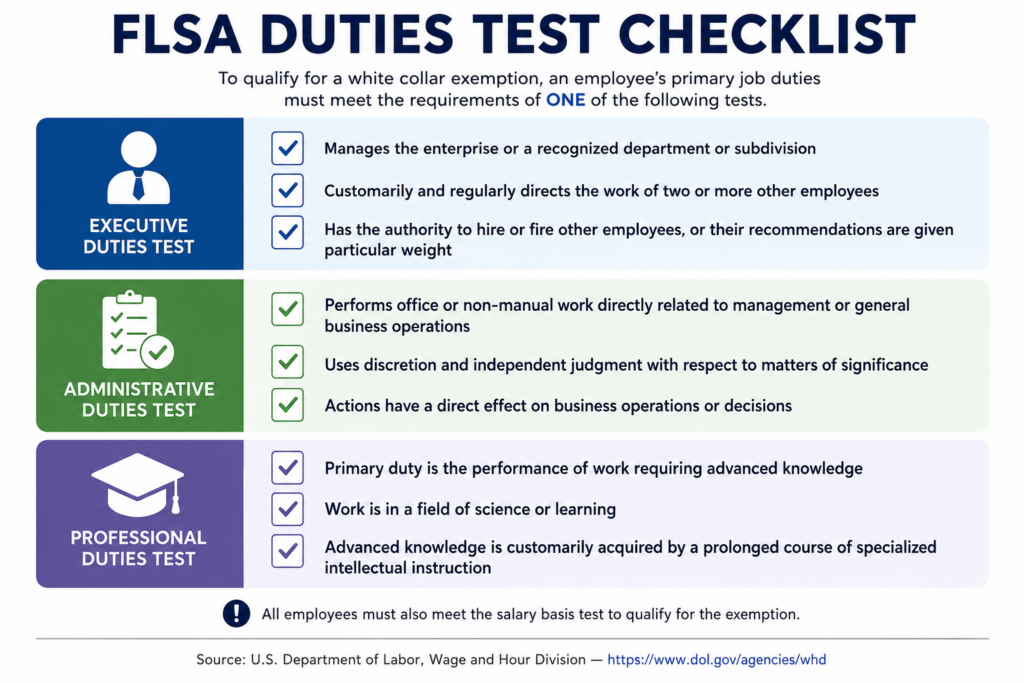
Meeting the salary threshold alone doesn’t make an employee exempt — their actual job duties have to fit one of three main categories.
- Executive exemption — primary duty is managing the business or a recognized department, regularly directs the work of at least two full-time employees, and has real input into hiring, firing, or promotion decisions.
- Administrative exemption — primary duty is office or non-manual work directly related to management or general business operations, and involves the exercise of discretion and independent judgment on significant matters.
- Professional exemption — primary duty requires advanced knowledge in a field of science or learning, typically obtained through prolonged, specialized education, such as accounting, law, or engineering.
What does it cost to misclassify an employee?
Misclassifying a non-exempt employee as exempt means you likely owe them back overtime pay, and the exposure doesn’t stop there.
- Back overtime wages for up to two years, or three years if the violation is found to be willful.
- Liquidated damages equal to the unpaid overtime, effectively doubling what you owe.
- Civil penalties for repeated or willful violations, on top of the wages themselves.
- Legal costs, whether the claim comes from a DOL audit or an employee lawsuit.
How do you correctly classify an employee?
Classification should be based on the actual job, not the job title or how convenient it would be to avoid paying overtime.
- Confirm the salary basis. Are they paid a fixed salary of at least $684 a week, regardless of hours worked or quality of work?
- Compare actual duties to the tests. Does the role genuinely meet the executive, administrative, or professional duties test, not just a job title that sounds like it should?
- Document your reasoning. Keep a record of why each exempt role qualifies, since the burden of proof falls on the employer if it’s challenged.
- Review after role changes. A promotion, a change in responsibilities, or a reorganization can shift a role’s classification without anyone updating the paperwork.
- Get a second opinion when it’s close. If a role doesn’t clearly meet the duties test, classify it as non-exempt or consult an HR or legal professional before deciding otherwise.
| Next step: Not sure if your team is classified correctly? Book a consultation with Blaize Accounting Services, and we’ll review your payroll setup. |
Frequently asked questions
What is the salary threshold for exempt employees in 2026?
The federal threshold is $684 per week, or $35,568 per year. New Jersey follows this same federal threshold rather than setting a higher state-specific level.
Can a salaried employee still be entitled to overtime?
Yes. Being paid a salary alone doesn’t make an employee exempt — they also have to meet one of the duties tests. A salaried employee who doesn’t meet a duties test is still entitled to overtime.
What happens if I misclassify an employee as exempt?
You may owe up to two or three years of back overtime pay, plus liquidated damages equal to that amount, and potentially civil penalties if the violation is found to be willful.
Does New Jersey have its own salary threshold for exempt employees?
No. New Jersey adopts the federal FLSA salary threshold by reference rather than setting its own, unlike states such as New York and California.
How often should I review employee classifications?
Review classifications whenever a role’s duties or compensation changes, such as after a promotion or reorganization, and do a full review at least annually as part of your payroll audit.
| Work with Blaize Accounting Services: Blaize Accounting Services helps small businesses across Bergen, Passaic, Essex, Morris, and Hudson counties classify employees correctly and keep payroll compliant with FLSA and New Jersey wage and hour rules. Schedule a consultation to get your payroll reviewed. |
ABOUT THE AUTHOR
Tania Blaize is the founder of Blaize Accounting Services, based in Bergen County, NJ, with more than 20 years of experience in bookkeeping, accounting, and tax planning. She works with small businesses and high-net-worth individuals across Northern NJ, including Passaic, Essex, Morris, and Hudson counties.
This article is general information, not legal advice. Employee classification depends on the specific facts of each role — consult an employment attorney or HR professional before making classification decisions for your business.
