
filed in
Mid-Year Financial Checkup: Organize Your Business Finances This Summer

A mid-year financial checkup means organizing your paperwork, reconciling your accounts, reviewing spending, and resetting your budget before the second half of the year gets underway. It takes a few hours now and saves you from scrambling at tax time.
Halfway through the year is the natural point to see what’s actually working in your business finances and fix what isn’t, before Q3 and Q4 lock in another six months of the same habits.
Why does your business need a mid-year financial checkup?
A cluttered financial system leads to missed deductions, costly errors, and last-minute stress every tax season. A mid-year checkup catches those problems in July instead of April, while there’s still time to fix them.
| What is a mid-year financial checkup? A mid-year financial checkup is a structured review of your business’s financial records — paperwork, bank reconciliations, spending, and budget — done partway through the year to catch errors early and reset your plan for the months ahead. |
Below is the checklist we walk clients through every summer, organized in the order it actually gets done.
How do you organize your business paperwork?
Start by gathering everything: bank statements, invoices, receipts, and tax documents from the first half of the year. A filing system only works if everything is in one place before you start sorting it.
- Gather documents — bank statements, invoices, receipts, and tax paperwork from January through June.
- Build a filing system — physical or digital, organized by month or vendor, whatever you’ll actually maintain.
- Dispose of outdated records securely — shred paper documents you no longer need to keep; see the retention guidance below before you toss anything.
Why does reconciling your accounts matter?
Reconciling means comparing your bank statements against your accounting records line by line to confirm they match. It’s the single fastest way to catch a bookkeeping error or an unauthorized charge before it compounds.
- Compare each bank statement against your accounting records for the same period.
- Correct discrepancies as soon as you find them, not at year-end.
- Reconcile monthly rather than quarterly — small errors are easier to trace closer to when they happened.
Where should you cut costs mid-year?
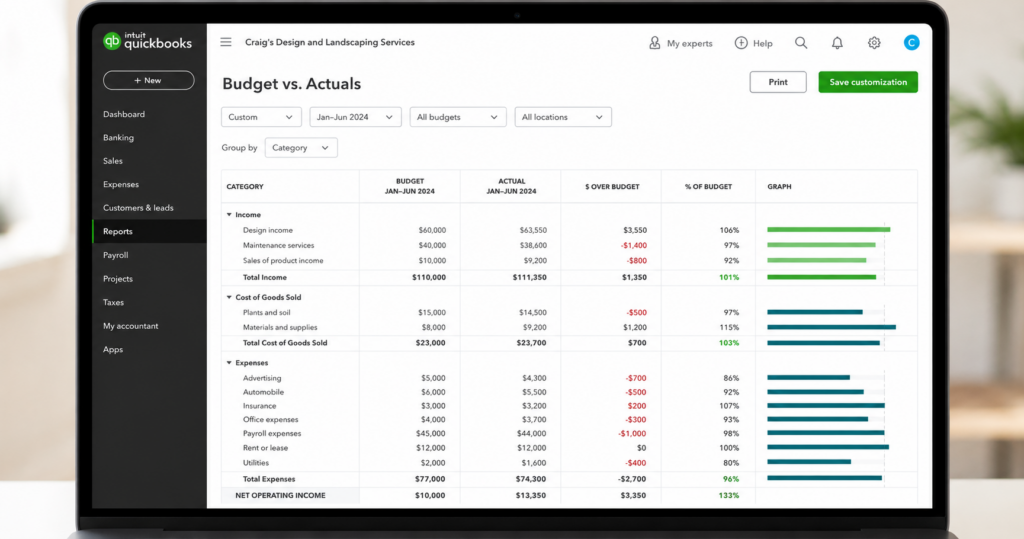
Look at your actual first-half spending against what you budgeted, then target the categories where the gap is largest.
- Recurring expenses — subscriptions, software, and services you’re paying for but not using fully.
- Supplier rates — six months of order history is often enough leverage to renegotiate.
- Marketing spend — check which campaigns actually produced customers versus which just produced impressions.
How do you rebuild your budget for the second half of the year?
Take what actually happened in the first six months — not what you originally projected — and build the next two quarters from that number.
| Checkup area | What to do | Where to track it |
|---|---|---|
| Paperwork | Gather and file statements, invoices, receipts | Digital filing system or QuickBooks Online attachments |
| Reconciliation | Match bank statements to accounting records monthly | QuickBooks Online Banking feed |
| Spending review | Compare actual vs. budgeted costs by category | QuickBooks Online Profit and Loss report |
| Budget reset | Rebuild Q3/Q4 targets from first-half actuals | QuickBooks Online budgeting tools |
QuickBooks Online makes this step faster because the reports pull directly from your reconciled transactions instead of a spreadsheet you’re rebuilding from scratch — you can access it from anywhere and generate the reports you need to make the call.
How can you grow your business through the rest of the year?
Once your books are current, the same mid-year window is a good time to look at growth, not just cleanup.
- Review your pricing — confirm it reflects the value you deliver, and consider a summer promotion to bring in new customers.
- Refresh your online presence — update your website and social profiles, and engage the audience you already have.
- Network and collaborate — industry events and partnerships often move faster in the back half of the year.
- Invest in professional development — a course or workshop now pays off before your busy season.
- Plan Q3 and Q4 — set concrete goals and revisit your business plan against where you actually stand today.
| Next step: Not sure where your books actually stand at the halfway point? Book a free consultation with Blaize Accounting Services, and we’ll walk through it together. |
Frequently asked questions
What is a mid-year financial checkup?
A mid-year financial checkup is a review of your business’s paperwork, bank reconciliations, spending, and budget done partway through the year, so you can fix problems early instead of finding them at tax time.
How often should I reconcile my business bank accounts?
Monthly. Reconciling every month makes errors and unauthorized charges easier to trace than waiting until quarter-end or year-end.
How long should I keep business financial records?
The IRS generally recommends keeping tax records for at least three years, and up to seven years if you’re claiming a loss from bad debt or worthless securities. Employment tax records should be kept at least four years.
Is QuickBooks Online worth it for a small business?
For most small businesses, yes — it centralizes bank reconciliation, expense tracking, and reporting in one cloud-based system you can access from anywhere, which removes a lot of the manual spreadsheet work a mid-year checkup would otherwise require.
How do I set financial goals for the rest of the year?
Start from your actual first-half numbers, not your original projection, then set Q3 and Q4 targets based on what you now know about your real revenue, expenses, and margins.
| Work with Blaize Accounting Services: Blaize Accounting Services helps small businesses across Bergen, Passaic, Essex, Morris, and Hudson counties get their records in order, streamline bookkeeping, and understand exactly where their finances stand. Schedule your free consultation today. |
ABOUT THE AUTHOR
Tania Blaize is the founder of Blaize Accounting Services, based in Bergen County, NJ, with more than 20 years of experience in bookkeeping, accounting, and tax planning. She works with small businesses and high-net-worth individuals across Northern NJ, including Passaic, Essex, Morris, and Hudson counties.
This article is general information, not tax or legal advice for your specific situation. Consult a qualified professional about how these steps apply to your own books.
