
filed in
The Case of the Missing Cash: How I Helped a Small Business Recover Thousands
Tania Blaize, Founder, Blaize Accounting Services | July 23, 2026

Cash handling procedures are the written steps a business follows to count, record, secure, deposit, and reconcile the money it takes in. For most small businesses, four rules cover it: log cash the day you receive it, deposit on a fixed schedule, match deposits against recorded sales every week, and have a second set of eyes on the total.
Skip those steps and money doesn’t disappear all at once. It leaks. I learned exactly how quietly it leaks during what was supposed to be a routine bookkeeping review for a client here in Bergen County.
What are cash handling procedures for a small business?
| Definition: Cash handling procedures are the written rules a business follows to collect, count, record, secure, deposit, and reconcile incoming payments. They assign each step to a named person, set a deposit schedule, and require that recorded sales be matched against bank deposits on a fixed, recurring basis. |
In a large company, these rules are enforced by an accounting department. In a business with three employees, they usually live in one person’s head — which means they exist right up until that person gets busy, gets sick, or leaves.
That’s the real vulnerability for small businesses. Not dishonesty. Overload. The owner is running sales, staffing, and service, and nobody is assigned the boring job of proving that what was sold equals what was banked.
How a routine bookkeeping review uncovered thousands in missing cash
The gap showed up in a comparison anyone can run: recorded sales versus actual bank deposits. Sales reports looked strong. Deposits didn’t match them. That mismatch is rarely a rounding issue; it’s a signal, and it’s worth chasing to the dollar.
So I traced it transaction by transaction. Two things surfaced:
- Cash collected but never deposited. Money had come in from sales, been set aside in a drawer, and simply never made it to the bank. No one had stolen it. No one had missed it either, because nothing in the routine ever asked the question.
- An invoice that was undercharged. A miscalculation meant part of a job was billed short. The work was delivered, the client paid what they were asked to pay, and the difference was never invoiced.
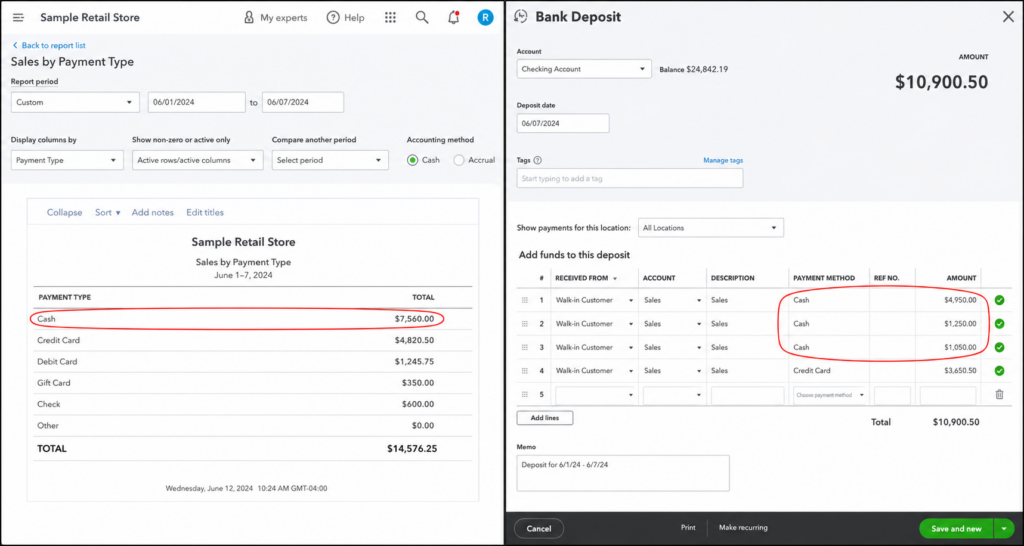
A few days and a few phone calls later, the shortfall was collected, and the cash was deposited. My client recovered thousands of dollars they had already earned — money that was sitting in their own building and on their own invoice, uncollected.
| The uncomfortable part: Nothing dramatic happened here. There was no theft, no bad actor, no crisis. That is exactly what makes this pattern so common — and so easy to miss for years. |
Why small cash gaps turn into large losses
Cash problems compound because the clock keeps running until someone catches them. The Association of Certified Fraud Examiners tracks this precisely, and its Occupational Fraud 2026: A Report to the Nations puts hard numbers on how much detection speed is worth.
| ACFE 2026 finding | Why it matters to a small business |
|---|---|
| Median loss per case: $104,000 | One unaddressed gap is not a rounding error |
| Asset misappropriation appears in 90% of cases | Cash and inventory are the most commonly lost assets |
| Median scheme runs 12 months before detection | A year of monthly reviews still missed it |
| Caught within 6 months: $40,000 median loss | Speed of detection is the single biggest lever |
| Running 5+ years: over $1.1 million median loss | The cost curve is steep, not linear |
| Over half of cases involved missing or overridden controls | The gap is usually procedural, not personal |
Read those figures as a range of outcomes for the same underlying problem. What separates a $40,000 loss from a $1.1 million one isn’t the severity of the gap — it’s how long the gap goes unexamined. The ACFE’s summary of the 2026 findings also notes that smaller organizations are especially exposed, largely because they have fewer controls and less separation of financial duties.
And that’s the fraud data. Honest mistakes — the undercharged invoice, the deposit that never happened — follow the same curve without anyone acting in bad faith.
What New Jersey expects you to document
New Jersey businesses that collect sales tax are required to keep contemporaneous sales records, which means records created at the time of the sale — cash register tapes and journals, sales slips, invoices, and receipts. That requirement sits in the New Jersey Administrative Code at 18:2-7.11, and it applies whether payment arrives as a card swipe or a twenty-dollar bill.
The consequence of thin records is worth understanding before an audit, not during one. Under that same section, if a corporation hasn’t kept records adequate to classify its income, the Division of Taxation may determine that unreported income was distributed to shareholders — and treat it first as salary, taxable to the shareholder personally.
Cash sales are still taxable sales
New Jersey applies Sales and Use Tax at 6.625% to most tangible personal property and certain services. A cash sale that never reaches your books is still a taxable sale — you simply lose the record that proves what you collected and remitted.
Federal recordkeeping runs on the same logic. The IRS expects you to keep documents supporting gross receipts, and its guidance on what kind of records to keep lists exactly the paper a cash business generates: register tapes, deposit information, receipt books, and invoices.
Five cash handling procedures that prevent lost revenue
These five procedures close the gaps that cost my client thousands. None of them require new software or a new hire.
- Reconcile weekly, not monthly. Match sales receipts to bank deposits every week. Monthly reconciliation means a mistake made on the 2nd sits undetected for 30 days — long enough for the drawer to be counted a dozen more times and for nobody to remember what happened.
- Write the cash routine down and put names on it. Count and log cash the same day it’s received. Deposit on set days, not when someone has a free hour. Name the person who counts, the person who deposits, and the person who reviews. A procedure with no name attached is a suggestion.
- Separate the duties you can. Full segregation of duties is unrealistic with three employees, but you can almost always split *counting* from *depositing*, or have the owner review the deposit log against the sales report weekly. Splitting one step is dramatically better than splitting none.
- Audit invoices before they go out, and balance every week. The undercharged invoice cost my client as much as the missing drawer cash. Review invoices for math and scope before sending. Then pull an accounts receivable aging report weekly and chase anything past 30 days while the work is still fresh in the client’s mind.
- Let the software do the matching. Bank feeds in QuickBooks Online or Xero reconcile continuously and flag unmatched transactions automatically, which turns a manual hunt into a short review. Automation won’t catch cash that never got deposited — but it will show you a deposit that doesn’t match a recorded sale.
How to run a 15-minute weekly cash check
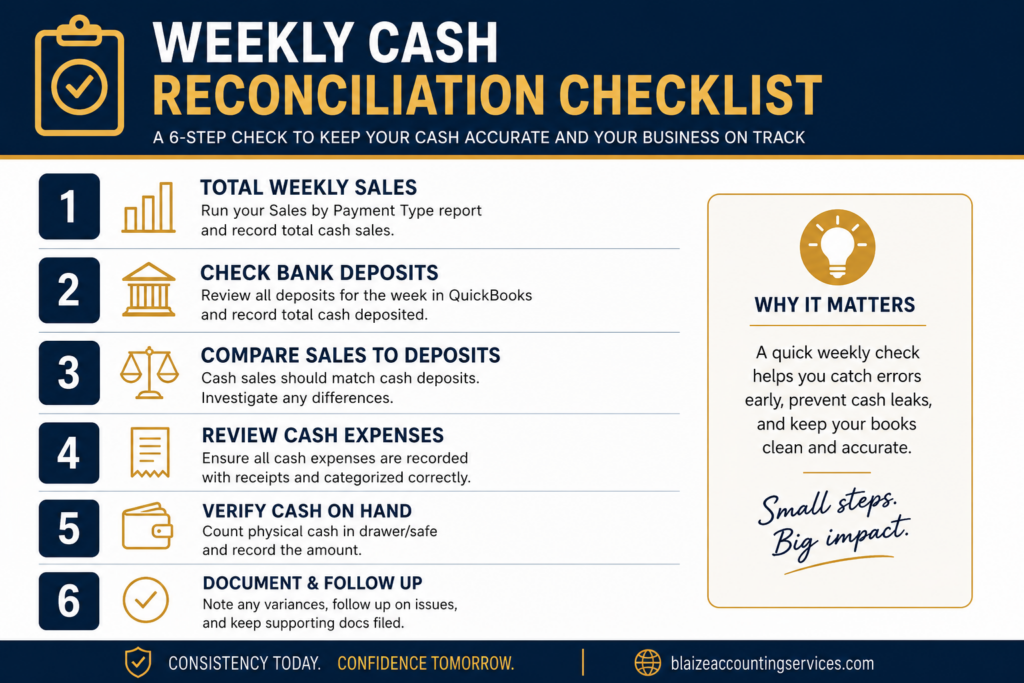
Here is the review itself, start to finish. Do it the same day every week — most owners find Monday morning works because the prior week is closed.
- Print or export last week’s total recorded sales by payment type: cash, card, check, and any online channel.
- Pull last week’s bank deposits, plus your card processor’s payout report.
- Compare the two totals by payment type, not in aggregate. Aggregate totals hide offsetting errors.
- Investigate every difference over your threshold — for most small businesses, anything above $25 deserves an explanation.
- Check your accounts receivable aging report for invoices past 30 days, and send reminders that day.
- Log the review: date, who ran it, what the variance was, and how it was resolved. Two minutes of documentation is what turns a habit into a control.
If you want this in checklist form, we publish a free monthly bookkeeping checklist you can hand to whoever runs the review.
Warning signs your business is losing cash
Any one of these on its own is worth a closer look. Two or more together means run the reconciliation this week.
- Sales reports look strong, but the bank balance doesn’t reflect it
- Deposits happen irregularly, or in inconsistent amounts
- One person counts, deposits, and records cash with no review
- Bank reconciliations are more than a month behind
- Invoices go out without a second review for math or scope
- You have unexplained write-offs, or you can’t easily explain a variance from last quarter
| Next step: Not sure whether your books are hiding money? A bookkeeping review will tell you in a matter of days. Book a consultation. |
Frequently asked questions about small business cash handling
What are cash handling procedures for a small business?
They are the written rules covering how money is collected, counted, recorded, secured, deposited, and reconciled. At a minimum, a small business should log cash as it comes in, deposit on a fixed schedule, match deposits to recorded sales weekly, and have someone other than the counter review the totals.
How often should a small business reconcile its bank account?
Weekly. Monthly reconciliation is the standard advice, but it means an error can sit for 30 days before anyone looks at it. A weekly comparison of recorded sales to actual deposits takes about 15 minutes and catches problems while people still remember the transactions.
Can a business with only two or three employees separate cash duties?
Partially, and partial separation still helps. Have one person count and log the cash and a different person make the deposit, or have the owner review the deposit log against the sales report each week. Splitting one step in the chain removes the situation where a single person handles money end to end with no review.
What cash records does New Jersey require a business to keep?
Businesses collecting New Jersey Sales and Use Tax must keep contemporaneous sales records — cash register tapes and journals, sales slips, invoices, and receipts. Inadequate records give the Division of Taxation room to determine that unreported income was distributed to shareholders and to treat it as taxable salary.
How do I know if money is missing from my business?
Compare recorded sales to bank deposits by payment type for a single week. If cash sales exceed cash deposits, or card sales don’t tie to processor payouts, you have a gap. Repeat for three consecutive weeks — a pattern tells you whether it’s a one-time error or a hole in the process.
How much does a bookkeeping review cost compared to what it recovers?
It varies by the size and condition of the books, but the arithmetic tends to favor the review. In the case described above, a routine review recovered thousands of dollars in a few days. Even when a review finds nothing missing, it produces documented procedures that prevent the next gap.
| Work with Blaize Accounting Services: Blaize Accounting Services works with small businesses and high-net-worth individuals across Bergen, Passaic, Essex, Morris, and Hudson counties, building the cash controls, clean books, and accounting and advisory support that keep earned revenue from quietly disappearing. Book a consultation or get in touch. |
ABOUT THE AUTHOR
Tania Blaize is the founder of Blaize Accounting Services, an accounting and bookkeeping firm based in Bergenfield, New Jersey. With more than 20 years in accounting, she works with small businesses and high-net-worth individuals across Northern New Jersey on bookkeeping, QuickBooks Online, payroll compliance, and financial advisory — with a particular focus on building the everyday controls that keep earned revenue from slipping away.
This article provides general information and is not tax, legal, or accounting advice for any specific situation. Tax rules and rates change. Consult a qualified professional about your own facts before acting.
