
filed in
Should You Outsource Bookkeeping? A Guide for Bergen County Startups

Most Bergen County startups should outsource bookkeeping once they’re recording more than about 50 to 75 transactions a month or bringing on their first employee — whichever comes first. Below that threshold, a founder can often manage their own books in QuickBooks Online or Xero without losing significant time.
The harder question isn’t whether outsourcing eventually makes sense — it almost always does — but when. Here’s how to tell if you’re there, what it actually costs, and what the first three months with a bookkeeping firm look like.
What does outsourcing bookkeeping actually mean?
Outsourcing bookkeeping means hiring a third-party bookkeeper or firm to record transactions, reconcile accounts, and produce financial statements for your business, instead of doing it yourself or hiring an in-house employee.
| Definition: A virtual bookkeeping provider is an outsourced bookkeeping firm that works entirely through cloud software and remote communication — no in-person office visits required — while still assigning your business a dedicated bookkeeper who reconciles your accounts on a set schedule. |
Signs your startup is ready to outsource
- You’re spending more than 3–4 hours a month on bookkeeping and that time would be better spent on the business itself.
- You’ve hired your first employee and now have payroll, withholding, and workers’ comp to track correctly.
- You’re raising money or applying for a loan and need clean, investor-ready financials on short notice.
- Your books are already behind, and the backlog keeps growing instead of shrinking.
- You genuinely don’t know your monthly burn rate without opening several different accounts to check.
Any single sign on this list is worth taking seriously; two or more together is a strong signal that the founder time being spent on bookkeeping is costing more than it’s saving. None of these signs require your startup to be large — the smallest businesses we work with are often the ones who benefit most, precisely because a founder’s time is scarcer, not more abundant, in the earliest stages. Waiting for the business to feel ‘big enough’ to justify outsourcing usually means waiting past the point where the backlog is easy to fix.
Two founders, two timelines
The clearest way to see what timing actually costs or saves for a startup is through two composite examples, drawn from patterns we see often, with identifying details changed.
The founder who waited too long
A software startup founder kept his own books in a spreadsheet through his first fourteen months, alongside a QuickBooks Online subscription he barely touched. When he started raising a seed round, his lead investor’s diligence team asked for clean, categorized financials going back to incorporation. What he had instead was a spreadsheet that didn’t match his bank statements, a QuickBooks file that was months out of sync, and no real answer for his burn rate beyond a rough guess. Getting the books investor-ready took several weeks of cleanup work, running in parallel with term sheet negotiations exactly the moment he had the least bandwidth to spare. The round still closed, but the founder was clear afterward that he wished he’d brought in help a year earlier, when the backlog would have been a fraction of the size.
The founder who outsourced early
A second founder, running an e-commerce startup, brought in outsourced bookkeeping the month she hired her first part-time employee, well before anyone would have called her business complex. It felt early at the time. Fourteen months later, when a strategic buyer approached her about an acquisition, her financials were already clean, monthly, and reconciled going back to her first transaction. Due diligence moved in weeks instead of months, and nothing about her books became a negotiating point. The cost of outsourcing that early was small and steady; the value showed up entirely on the other end, when it mattered most. Looking back, she’s said the decision felt almost too cautious in year one and turned out to be the single easiest problem she never had to solve later.
Outsourced vs in-house vs DIY: cost and time compared
These are general market ranges, not a fixed price list; every legitimate firm, including ours, scopes outsourced bookkeeping around a startup’s actual transaction volume and complexity rather than a flat number. Use the table below to compare the shape of each option, not as a quote.
| Option | Typical monthly cost | Founder time required |
|---|---|---|
| DIY in QuickBooks/Xero | $20 – $115 (software only) | 3–10+ hours/month, grows with volume |
| Outsourced bookkeeping service | $300 – $1,500 for most early-stage startups | Under 1 hour/month for review |
| In-house bookkeeper (part-time) | $1,500 – $3,000+ | Management time, plus hiring and training |
For a full breakdown of what drives outsourced pricing up or down, see our Bergen County bookkeeping cost guide.
The DIY column is deceptive at first glance, because the dollar cost looks lowest. What it hides is the founder’s own time, valued at whatever a founder’s hour is actually worth to the business — and for most early-stage founders, that hour is worth considerably more spent on product, sales, or fundraising than on categorizing transactions. The real comparison isn’t dollars against dollars; it’s dollars against founder hours redirected toward growth. The in-house column looks appealing once a startup has meaningful headcount, but below roughly 15 to 20 employees, the fixed cost of a dedicated hire rarely pencils out against outsourcing.
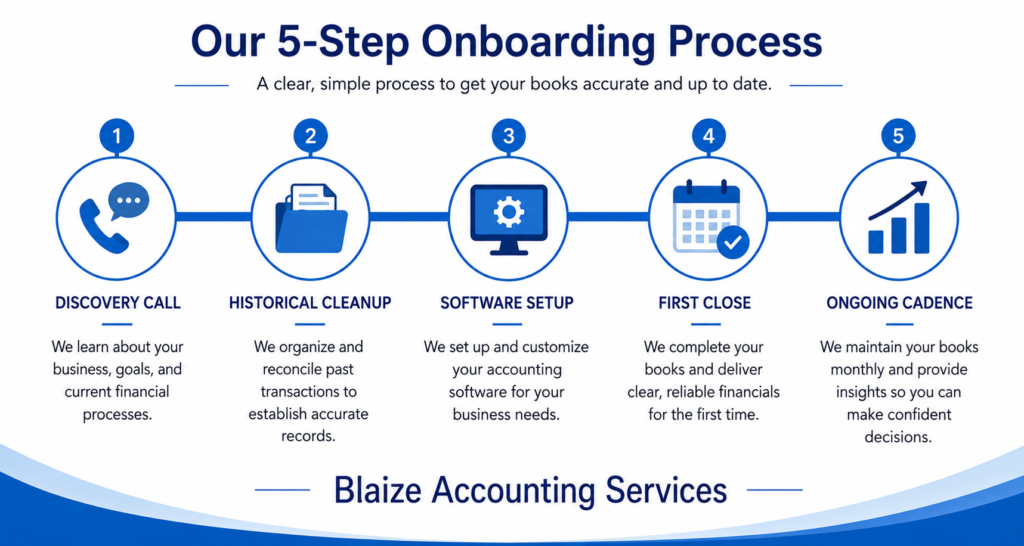
What to expect during onboarding
Onboarding is where a lot of the anxiety around outsourcing lives. Founders worry about handing over access to sensitive financial data, or about the disruption of switching systems mid-operation. In practice, a well-run onboarding is more procedural than dramatic.
- Discovery call — the firm reviews your current books, software, and transaction volume.
- Historical cleanup — any backlog gets reconciled before regular monthly service starts.
- Bank feed and software setup — accounts get connected, and categorization rules are built.
- First monthly close — you receive your first full profit and loss and balance sheet on the agreed schedule.
- Ongoing cadence — monthly check-ins or reports, with your bookkeeper flagging anything unusual as it happens.
The discovery call is worth taking seriously on your end, even though it can feel like a formality. The more specific you can be about your transaction volume, your existing software setup, and how far behind (if at all) your books are, the more accurate the resulting scope and timeline will be. Vague answers here are the most common reason an onboarding runs longer than expected.
Virtual vs local: what matters most for a startup
For most startups, response time matters more than location. A virtual bookkeeping provider serving Bergen County clients can usually turn around questions faster than scheduling an in-person meeting, and cloud software makes the physical location of your bookkeeper close to irrelevant day to day.
The one place local knowledge still counts is New Jersey-specific compliance, sales tax nexus, CBT-100S filings for S corporations, and state payroll withholding. So confirm your provider, wherever they sit, actually works with New Jersey businesses regularly.
| Next step: Not sure if you’ve crossed the threshold yet? Book a consultation, and we’ll look at your actual numbers. |
Frequently asked questions
When should a startup outsource its bookkeeping?
Most startups should outsource once they’re processing more than about 50 to 75 transactions a month or hire their first employee, whichever happens first.
What are the benefits of outsourcing bookkeeping for a startup?
Outsourcing frees up founder time, reduces the risk of errors that surface later at tax time, and produces clean, investor-ready financials on a predictable schedule.
How much does outsourced bookkeeping cost for an early-stage startup?
Most early-stage startups pay $300 to $1,500 a month, depending on transaction volume and whether payroll is included.
Can a virtual bookkeeping provider serve a Bergen County business well?
Yes, as long as the provider works regularly with New Jersey businesses and understands state-specific requirements like sales tax nexus and CBT-100S filings for S corporations.
How long does onboarding with an outsourced bookkeeper take?
Most startups complete discovery, historical cleanup, and software setup within 2 to 4 weeks, depending on how far behind the books are when the engagement starts.
| Work with Blaize Accounting Services: Blaize Accounting Services works with Bergen County startups from their first employee through their first raise. Schedule a call to talk through where you are. |
ABOUT THE AUTHOR
Tania Blaize is the founder of Blaize Accounting Services, a Bergen County firm providing bookkeeping, QuickBooks and Xero support, and tax planning for small businesses and high-net-worth individuals across Northern New Jersey. She has more than 20 years of experience helping founders get their books under control before it becomes a bigger problem.
This article is general information, not tax or accounting advice for your specific situation. Consult a qualified professional about your own facts before making a decision.
