
filed in
How to Fix Messy Bookkeeping: An 8 Step Cleanup Plan for NJ Business Owners

You fix messy bookkeeping by reconciling every bank, credit card, and loan account to its statements, clearing uncategorized transactions, separating personal spending from business, and locking the finished periods. Most small businesses can get current with a structured, month-by-month pass, then stay current with a short monthly routine.
Blaize Accounting Services, an accounting firm in Bergen County, New Jersey, cleans up books for small business owners and high-net-worth individuals across Northern New Jersey. This guide gives you the same eight-step process we use, plus the penalties and deadlines that make cleanup worth doing now.
What counts as messy bookkeeping?
Messy bookkeeping means your books no longer match reality, so you cannot trust the numbers on your reports. The cause is usually simple: reconciliations were skipped, transactions were left uncategorized, or personal and business spending got mixed together.
| Definition: Messy bookkeeping is a set of accounting records that are incomplete, unreconciled, or miscategorized, so the reports do not match your bank statements. It shows up as uncategorized transactions, unexplained balances, missing receipts, and profit figures you cannot rely on for taxes or decisions. |
Most of the business owners we meet in Bergen County are not careless. They are busy running a company, and the books slipped when the work got heavy. The good news is that almost every mess follows the same patterns, which means it can be fixed with the same repeatable process.
Common signs your books need a cleanup
| Warning sign | What it usually means | Why it matters |
|---|---|---|
| Large Uncategorized or Ask My Accountant balance | Transactions were imported but never reviewed | Expenses go unclaimed, and profit is misstated |
| Bank balance does not match the books | Reconciliations were skipped or done incorrectly | Every report built on that account is unreliable |
| Owner spending mixed with business spending | No clear line between personal and company money | Weakens deductions and creates audit risk |
| Negative or odd balances on the balance sheet | Deposits, loans, or payroll posted to the wrong accounts | Lenders and your CPA will question the whole file |
| Missing 1099 information for contractors | No W-9s and no clean vendor totals | Filing errors and penalty exposure |
Why does messy bookkeeping cost you money?
Messy bookkeeping costs you money through missed deductions, late filing penalties, higher preparation time, and decisions made on wrong numbers. The expense is rarely one big bill. It builds quietly across the year and lands at tax time.
- Missed deductions. If a legitimate expense is buried in an uncategorized bucket or has no receipt, it is easy to leave off the return. The IRS notes that you must be able to prove certain expenses to deduct them, as described in the IRS recordkeeping guidance for small businesses.
- Late filing penalties. For partnership and S corporation returns due after December 31, 2025, the IRS charges $255 per partner or shareholder for each month a return is late, for up to 12 months, per the IRS failure to file penalty rates. A three-owner company that files five months late can owe $3,825 before any tax is counted.
- Individual penalties. Late individual returns can owe 5% of the unpaid tax for each month, up to 25%, with a $525 minimum if the return is more than 60 days late.
- Contractor reporting errors. The Form 1099-NEC threshold rises to $2,000 for payments made after December 31, 2025, according to the IRS Form 1099-NEC guidance. You still need a W-9 and clean payment totals for every contractor who crosses it.
- Weak financing files. Banks, landlords, and buyers ask for reconciled financials. Books that do not tie out slow deals down or kill them.
Clean books also make tax planning possible. You cannot plan around a number you do not trust. That is why we treat cleanup as the first step of tax planning, not a separate chore.
How do you fix messy bookkeeping step by step?
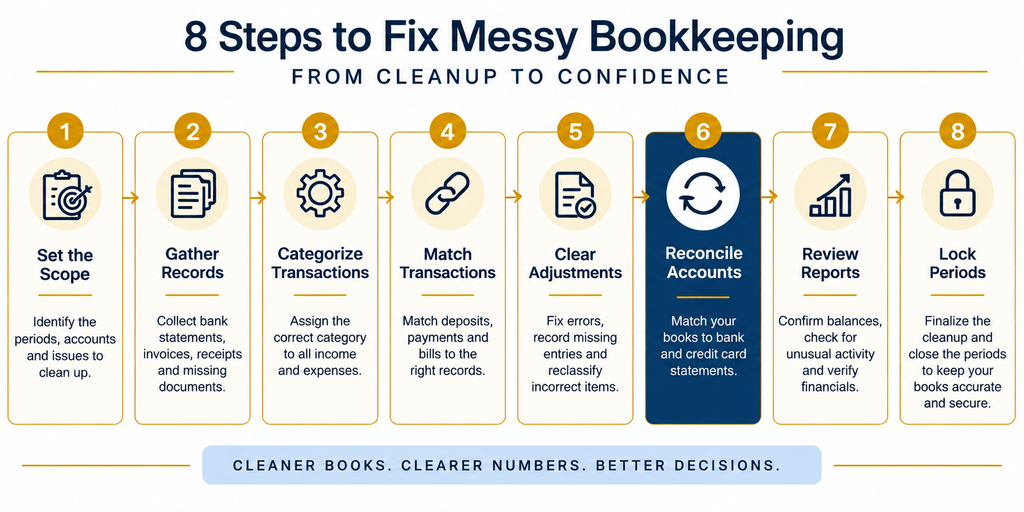
You fix messy bookkeeping by working through eight steps in order: set the scope, gather statements, reconcile oldest first, clear uncategorized items, separate personal spending, clean up lists and subledgers, review the balance sheet, and lock the periods. Order matters because each step depends on the one before it.
- Set the scope and the start date. Decide how far back you need clean books. For most owners, that is the start of the current tax year, plus any prior year that was never filed or reconciled.
- Gather every statement and source document. Collect bank, credit card, loan, merchant processor, and payroll statements for the whole period, along with receipts, invoices, and contractor W-9s. Missing statements are the number one reason a cleanup stalls.
- Reconcile the oldest month first. Match each account to its statement, one month at a time, so every ending balance becomes the next month’s opening balance. Skipping ahead hides errors that reappear later.
- Clear the uncategorized buckets. Review every transaction sitting in Uncategorized Income, Uncategorized Expense, and Ask My Accountant, and assign it to the right account. Add bank rules only after the history is correct.
- Separate personal from business. Move personal spending out of expense accounts. Depending on your entity type, it belongs in owner draws, shareholder distributions, or a shareholder loan account. Ask your accountant before you choose.
- Clean up lists and subledgers. Merge duplicate vendors and customers, retire unused accounts, clear Undeposited Funds, and tie open invoices and bills to what is actually owed and owing.
- Review the balance sheet and payroll. Check that loans, sales tax, and payroll liabilities match the notices, returns, and statements behind them. A balance sheet that looks strange is your best audit of everything above.
- Lock the closed periods. Set a closing date with a password so no one changes finished months by accident. Then run a profit and loss report and confirm it makes business sense.
What do you do when statements are missing?
When statements are missing, request them from the bank or card issuer before you guess. Most institutions provide several years of statements online or by request. If a document truly cannot be recovered, record what the bank data shows and note the gap so your accountant can decide how to support it.
What does a real cleanup look like?
A real cleanup usually starts with an owner who says the books are a mess and ends with a file that finally ties to the bank. The composite example below is based on patterns we see often in Northern New Jersey and does not describe any single client.
Picture a Bergen County service business with two owners, one business checking account, and two credit cards. The bookkeeping was done in QuickBooks Online by whoever had time. When the accountant asked for financials, the file had eleven months unreconciled, a large Uncategorized Expense balance, and owner groceries mixed into supplies.
The fix followed the same order as the steps above. Statements were gathered first. Each account was reconciled from the oldest open month forward. Uncategorized items were reviewed in batches, personal charges were moved to owner draws, and contractor payments were matched to W-9s. Once the balance sheet tied out, the periods were locked.
The result was not only a cleaner file. The owners found deductible expenses that had been sitting in the wrong bucket, and the return was prepared from numbers everyone trusted. That is the real payoff of cleanup: fewer surprises, and a real starting point for planning.
Should you fix messy bookkeeping yourself or hire help?
You can fix messy bookkeeping yourself when the problems are small, and you should hire help when the records span multiple periods, involve payroll or sales tax, or will not reconcile after a real attempt. The right choice depends on time, risk, and how soon you need reliable numbers.
| Situation | Do it yourself | Bring in a professional |
|---|---|---|
| One or two unreconciled months | Reasonable if you have the statements | Optional |
| Uncategorized balance from a single quarter | Possible with bank rules and time | Helpful for tax accuracy |
| Several months or years behind | Slow and error-prone | Recommended |
| Payroll or sales tax balances look wrong | Risky | Strongly recommended |
| Unfiled returns or IRS or state notices | Not advised | Necessary |
| Preparing for a loan, sale, or audit | Not advised | Recommended |
Our fees for cleanup are scoped per engagement, because the work depends on the number of accounts, the months involved, and the condition of your records. A short review of your file is how we define the scope. If you want help with the tools and the process, our QuickBooks Online cleanup and bookkeeping services are built for exactly this situation.
How do you keep your books clean after the cleanup?
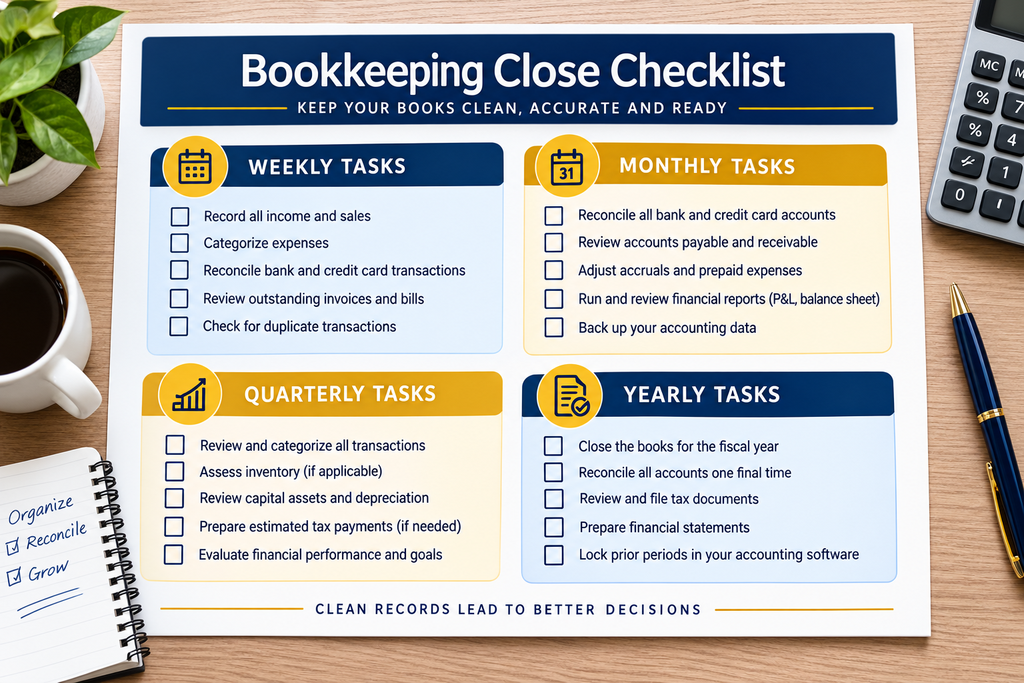
You keep books clean by doing a short, fixed routine every week and every month instead of a big catch-up once a year. Small habits are what prevent the next mess.
- Weekly: categorize new transactions, save receipts, and review anything unusual.
- Monthly: reconcile every bank, card, and loan account within a few days of the statement closing, then review the profit and loss report.
- Quarterly: confirm payroll and sales tax balances against the returns filed, and review estimated tax with your accountant.
- Yearly: collect W-9s from new contractors, confirm 1099 totals, and close the year with a locked period.
| Free checklist.Not sure your file is ready for tax season? Use our Are Your Books Tax Ready? checklist to see what is missing before your accountant asks. It takes a few minutes and shows you where to focus first. |
How long should you keep your business records?
Most business records should be kept for at least 3 years from the date you file the return, but some situations require longer. The table below summarizes the retention periods in the IRS guidance on how long to keep records.
| Situation | Keep records for |
|---|---|
| Standard income, deductions, and credits | 3 years |
| Income omitted that is more than 25% of gross income shown | 6 years |
| Bad debt deduction or worthless securities claim | 7 years |
| Employment tax records | At least 4 years after the tax is due or paid |
| No return filed, or a fraudulent return | Indefinitely |
| Property records | Until the limitations period ends for the year you dispose of the property |
Cleaning up your books is also a good moment to organize your documents. Store statements, receipts, and contractor forms digitally, name them consistently, and back them up. Digital copies are accepted for most purposes when they are complete and legible.
| Next step: Not sure how far back your books need to go? Book a consultation, and we will review your file and tell you what a cleanup would involve. |
Frequently asked questions about fixing messy bookkeeping
How do I fix messy bookkeeping?
Reconcile every bank, credit card, and loan account to its statements, starting with the oldest unreconciled month. Then clear uncategorized transactions, separate personal spending from business, review receivables, payables, and payroll balances, and lock the finished periods so they cannot change.
How long does it take to clean up messy books?
It depends on how many months are behind, how many accounts you have, and how complete your statements and receipts are. A single quarter of light problems can be finished quickly, while several years of gaps take longer. A scoped review of your records gives the only reliable estimate.
Can I fix my own bookkeeping in QuickBooks?
Yes, if the problems are limited to a few uncategorized transactions and one or two unreconciled months. Get help when you find missing years, payroll errors, sales tax balances that look wrong, or a balance sheet that will not tie to your bank statements.
What happens if my bookkeeping is wrong at tax time?
Your return may overstate income, miss deductions, or fail to match forms the IRS already received. Late partnership and S corporation returns carry a $255 per owner, per month penalty for up to 12 months, and individual returns can owe 5% of unpaid tax per month up to 25%.
Do I have to file 1099s for contractors if my books are behind?
Yes. The filing duty does not pause because your records are behind. For payments made after December 31, 2025, the Form 1099-NEC threshold is $2,000, and you need each contractor’s W-9 and accurate payment totals to file correctly.
How long do I need to keep my business records after cleanup?
Keep most records for at least 3 years from the date you file the return. Keep them 6 years if you omitted more than 25% of gross income, 7 years for bad debt or worthless securities claims, and at least 4 years for employment tax records.
Should I switch accounting software to fix messy books?
Usually not. Switching software moves the mess to a new system. Clean and reconcile the data first, then decide whether QuickBooks Online, Xero, or another platform fits your workflow. A clean file migrates far better than a messy one.
| Work with Blaize Accounting Services: Blaize Accounting Services helps Northern New Jersey business owners turn messy books into accurate, tax-ready records, with bookkeeping services, QuickBooks Online cleanup, payroll compliance, and tax planning. Book a consultation and start with a clear, scoped plan. |
ABOUT THE AUTHOR
Tania Blaize, EA is the founder and principal accountant of Blaize Accounting Services in Bergenfield, New Jersey. With over 20 years of experience, including senior manager roles at accounting advisory firms, she helps small business owners and high-net-worth individuals across Bergen, Passaic, Essex, Morris, and Hudson counties keep organized records, avoid missed deductions, and plan their taxes with confidence.
This article is general information, not tax or legal advice for a specific situation. Consult a qualified professional about your own facts.
