
filed in
Documents Needed for Personal Income Tax Preparation: Your 2026 Checklist

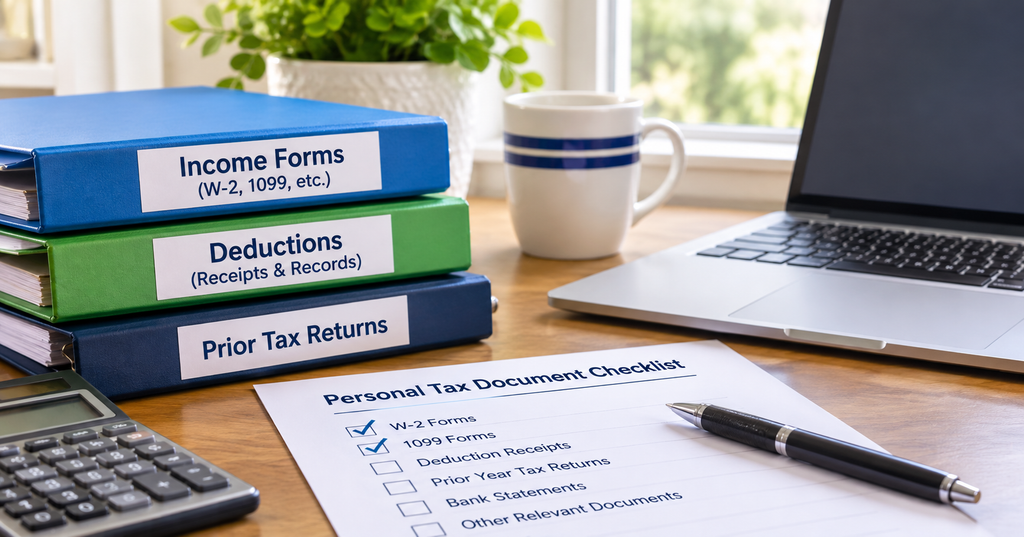
The documents needed for personal income tax preparation fall into four groups: identification and Social Security numbers, income forms such as W-2s and 1099s, records that support your deductions and credits, and last year’s tax return. Bring all four to your preparer, and you can file accurately, without delays or missed savings.
This checklist covers the 2026 tax year, the return you will file in early 2027. It explains what federal and New Jersey filers should gather, when each form should arrive, and the extra records that business owners, investors, and higher-income households often forget. At Blaize Accounting Services in Bergen County, we see the same pattern every season: the clients who organize first get the cleanest returns and find the most deductions. The IRS list of documents to gather is a good starting point, and this guide goes further.
What documents do you need to prepare a personal tax return?
You need four things: proof of identity, every form that reports income, records that support deductions and credits, and your prior year return. Your preparer uses them to confirm who you are, report everything you earned, and claim every tax break you qualify for.
| DefinitionPersonal income tax preparation documents are the records a taxpayer provides to report income, claim deductions and credits, and verify identity on a return. They include Social Security numbers, Forms W-2 and 1099, expense receipts, and the prior year return. Complete records reduce errors, speed up refunds, and protect you if the IRS asks questions. |
| Category | Examples | Why it matters |
|---|---|---|
| Identity and household | Photo ID, Social Security numbers, dates of birth, bank routing numbers | Prevents rejected e-files and delayed refunds |
| Income | W-2, 1099-NEC, 1099-INT, 1099-DIV, 1099-B, 1099-R, K-1 | Everything paid to you must be reported |
| Deductions and credits | Mortgage interest, property taxes, charity receipts, tuition, childcare | Lowers your taxable income or tax bill |
| History | Last year’s federal and New Jersey returns | Verifies your e-file signature and carries items forward |
What identity and household documents should you bring?
Bring a government photo ID plus the Social Security number or ITIN for every person on your return. The IRS also asks for your bank account and routing numbers and last year’s adjusted gross income.
- Photo ID and Social Security cards or ITIN letters for you, your spouse, and each dependent. One transposed digit can cause an e-file rejection.
- Dates of birth for everyone on the return, plus the name, address, and taxpayer ID of any childcare provider if you claim dependent care.
- Bank account and routing numbers for direct deposit of a refund or payment of a balance due.
- Last year’s federal and New Jersey returns. Your prior year adjusted gross income (AGI) is used to verify your electronic signature.
- Your IRS Identity Protection PIN (IP PIN) if the IRS issued you one. Without it, an e-filed return is rejected.
- Name and address changes. If you married, divorced, or moved, notify the Social Security Administration of a name change and the IRS of a new address before you file.
- ITIN status. The IRS says an ITIN that was not included on a federal return for tax years 2023, 2024, or 2025 expires on December 31, 2026, so check yours early.
Which income documents do you need?
You need every form that reports money paid to you in 2026, and the IRS advises waiting to file until all of them arrive. Payers must report what they paid you to the IRS and send you a copy, usually by mail or electronically in January or February, as described on the IRS gather your documents page.
| Form | What it reports | Usually comes from |
|---|---|---|
| W-2 | Wages and tax withheld | Your employer |
| 1099-NEC | Freelance and contractor pay (payers report $2,000 or more for 2026) | Clients you worked for |
| 1099-K | Payments through payment apps and online marketplaces (over $20,000 and more than 200 transactions) | Payment processors |
| 1099-INT and 1099-DIV | Interest and dividends | Banks and brokerages |
| 1099-B or consolidated 1099 | Stock and fund sales | Your brokerage |
| 1099-DA | Digital asset sales through a broker | Crypto exchanges |
| 1099-R | Retirement, pension, and IRA distributions | Plan custodian |
| SSA-1099 | Social Security benefits | Social Security Administration |
| 1099-G | Unemployment benefits and state refunds | State agencies |
| Schedule K-1 | Partnership, S corporation, estate, or trust income | The entity or trustee |
| 1095-A | Marketplace health coverage and premium credits | Health insurance Marketplace |
What about income that has no form?
Income is taxable even when nobody sends you a form. Rental income, cash from a side job, and tips you received directly all belong on your return. The IRS states that you must report all income whether or not you receive a Form 1099-K, 1099-NEC, or any other information return, so keep your own running records.
Digital assets deserve special care. The IRS notes that you must report all digital asset income, gains, and losses on your return whether or not a broker sends a Form 1099-DA. Export your full transaction history from every exchange and wallet. See the IRS get ready to file page for the current reporting questions.
When do tax forms arrive, and what if one is late or wrong?
Employers must send W-2s, and payers must send Forms 1099-NEC by February 1, 2027, because the usual January 31 date falls on a Sunday. Brokerage statements, K-1s, and corrected forms often arrive later, which is why filing in February can mean filing twice.
| Date | What happens |
|---|---|
| January 15, 2027 | Final 2026 estimated tax payment is due |
| Late January 2027 | IRS begins accepting 2026 returns (exact date announced by the IRS) |
| February 1, 2027 | W-2s and 1099-NECs are due to you |
| February and March 2027 | Brokerage 1099s, K-1s, and corrected forms commonly arrive |
| March 15, 2027 | Partnership and S corporation returns are due, so K-1s often follow |
| April 15, 2027 | Individual returns and any tax owed are due; an extension request must be filed by this date |
What to do when a form is missing or incorrect
- Contact the payer first. Ask your employer, bank, or brokerage to send or correct the form. Corrected W-2s are labeled W-2c.
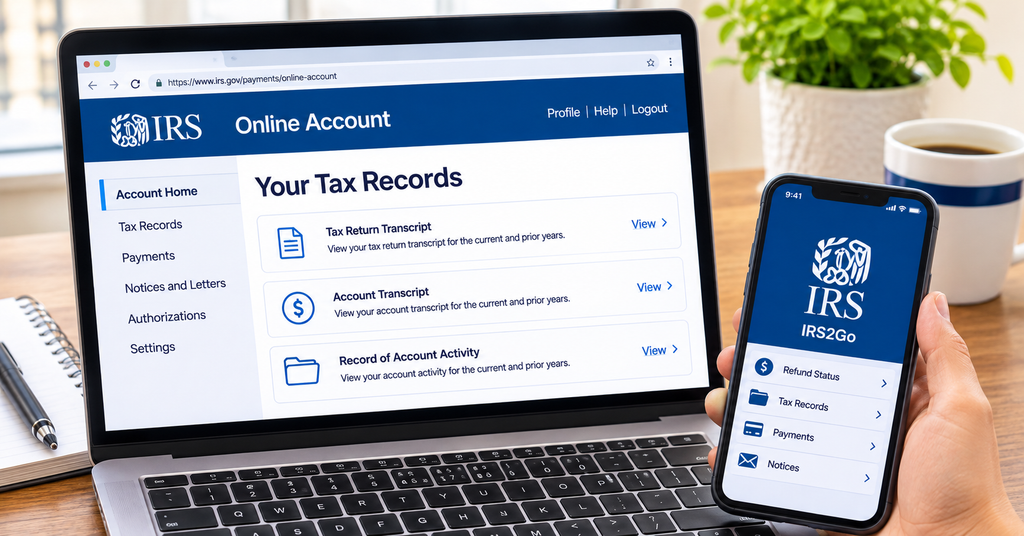
- Check your IRS Online Account. It can show available Forms W-2 and certain 1099s, plus your prior-year AGI.
- Use Form 4852 as a last resort. If you still cannot get the form, the IRS allows a substitute using your pay stubs, and you can estimate wages and withholding.
- Do not guess silently. Tell your preparer exactly which figures are estimates so the return can be amended if the real form differs.
An extension gives you until October 15 to file, but it does not extend the time to pay. Estimate what you owe and pay it by April 15 to avoid penalties.
Which documents support deductions and credits?
Bring a record for every expense you want counted: mortgage interest, property taxes, charitable gifts, education costs, childcare, and retirement or health savings contributions. The IRS lists these same categories as the records most taxpayers need to claim credits and deductions.
Homeowners and renters in New Jersey
- Form 1098 from your mortgage lender showing interest and points paid.
- Property tax bills and proof of payment for the year. New Jersey lets you take a property tax deduction of up to $15,000 or a $50 refundable credit, whichever helps more, as explained by the NJ Division of Taxation.
- Rent paid and your landlord’s name and address if you rent. Tenants may qualify for the same New Jersey property tax benefit.
- Closing disclosures if you bought, sold, or refinanced a home during the year.
Property taxes matter more than they used to for federal purposes too. The One Big Beautiful Bill Act raised the federal cap on state and local tax deductions from $10,000 to $40,000 beginning in 2025, with small annual increases through 2029 and a phase-down for higher incomes. For many Bergen, Essex, and Morris County homeowners, that can make itemizing worthwhile again, but only if your records are complete.
Education, family, and health
- Form 1098-T for tuition and Form 1098-E for student loan interest.
- Childcare receipts showing the amount paid and the provider’s name, address, and taxpayer ID.
- HSA and FSA statements, including contribution totals.
- Retirement contribution records for IRAs and other plans.
- Medical expense totals, only if you plan to itemize, since special limits apply.
Charitable giving
Keep a written acknowledgment from the charity for every gift of $250 or more, and bank records for smaller gifts. For donated goods, keep a list with dates and fair market values. For donor-advised fund gifts or appreciated stock, bring the transfer confirmations.
New for 2026: tips, overtime, car loan interest, and seniors
Several temporary deductions created by the One Big Beautiful Bill Act reached taxpayers on a new IRS form, Schedule 1-A, and they require specific paperwork. Income limits apply, and these breaks are scheduled to run through tax year 2028.
- Tips: qualifying tips must appear on a W-2, a 1099, another statement you received, or Form 4137. Keep your tip log if you report tips yourself.
- Overtime: the deduction applies to qualified overtime pay of up to $12,500, or $25,000 on a joint return. The IRS draft of the 2026 Form W-2 added Box 12 codes for several of these items, so read your W-2 line by line.
- Car loan interest: up to $10,000 a year for interest on a qualifying new vehicle. Bring the lender’s annual interest statement, the vehicle identification number (VIN), and the loan date.
- Age 65 and older: an additional deduction of $6,000 per eligible person, so bring dates of birth for you and your spouse.
What extra documents do business owners, investors, and high net worth filers need?
Self-employed taxpayers, landlords, and investors need records that most W-2 employees never touch. Missing any of them is the fastest way to lose a deduction or trigger an amended return. If you own a business, clean books make this step far easier, which is why we pair tax planning with ongoing bookkeeping.
- Self-employment: bank and payment app statements, invoices, mileage logs, receipts, home office measurements, and any Form 1099-NEC you received. Keep records of checks paid to you as well.
- Estimated tax payments: the date and amount of every federal and New Jersey payment you made for 2026.
- Rental property: rent records, repair and expense receipts, mortgage interest, property tax, insurance, and your depreciation schedule from last year’s return.
- Investments: consolidated 1099s, cost basis records for any shares you sold, and date of death values for inherited assets.
- Equity compensation: Forms 3921 or 3922 and employer statements for stock options, restricted stock, and employee stock purchase plans.
- Partnerships, S corporations, estates, and trusts: every Schedule K-1, which may arrive after the March 15 entity deadline.
- Foreign accounts: statements for any foreign bank or investment account, because reporting rules can apply when combined balances exceed $10,000 at any point in the year.
| From our practice.The two gaps we chase most often are missing estimated tax payment confirmations and missing stock cost basis records. Pull both before your appointment, and you can skip most of the follow-up questions. |
| Free resource.Business owners can also download our free tax readiness checklist, Are Your Books Tax Ready?, to confirm your bookkeeping is in order before tax season begins. If your books are behind, our QuickBooks Online setup and cleanup service can catch them up. |
How should you organize your tax documents?
Create one folder for tax year 2026, digital or paper, and file each document the day it arrives. A single organized folder prevents the end-of-season scramble and makes it easy to spot a missing form.
- Open the folder now. Label it Tax Year 2026 and add subfolders for income, deductions, business, and investments.
- Create or sign in to your IRS Online Account. It shows your prior year AGI and, once available, many W-2 and 1099 records.
- Log each form as it arrives. Check it against last year’s return so you notice anything that is missing.
- Review every form for errors. Confirm names, Social Security numbers, and dollar amounts, and ask the payer to correct mistakes right away.
- Share securely. Send documents through your preparer’s secure portal or encrypted upload, not regular email, because they contain Social Security and bank numbers.
How long should you keep tax records?
Keep your tax returns and supporting documents for at least three years from the date you file. The IRS recordkeeping guidance also says to keep records about property you sell or dispose of, because you need them to figure out your gain or loss.
- Three years: general rule for returns, W-2s, 1099s, receipts, and canceled checks.
- Longer: home purchase and sale records, stock transactions, IRA records, and business or rental property records.
- Four years: employment tax records, if you pay a household employee or run a business with employees.
- Up to six years: the IRS says it usually does not look back more than six years, even when it finds a substantial error.
Your own prior returns are the single most useful record. If you lose one, the IRS offers free tax transcripts, and copies of full returns are available for a fee.
| Next stepNot sure what applies to your situation? Book a tax preparation consultation, and we will send you a personalized document checklist before your appointment. |
Frequently asked questions
What documents do I need to give my accountant to file my taxes?
At minimum, bring photo ID and Social Security numbers for everyone on the return, every W-2 and 1099 you received, last year’s federal and New Jersey returns, and records for any deductions or credits you want to claim. Add business, rental, and investment records if they apply to you.
Do I need receipts if I take the standard deduction?
You do not need itemized receipts for the standard deduction itself. You still need all income forms, and some deductions you can take either way, such as HSA contributions, student loan interest, and car loan interest, require documentation. Bring your records so your preparer can compare standard and itemized results.
What should I do if I do not receive my W-2 by mid-February?
Contact your employer’s payroll department first, then check your IRS Online Account for available forms. If you still cannot get it, the IRS allows Form 4852 as a substitute, using your final pay stub to estimate wages and withholding.
Do I need different documents for my New Jersey return?
Mostly the same, plus a few New Jersey items. Bring property tax bills or proof of rent paid with your landlord’s name and address for the property tax deduction or credit, records of New Jersey estimated payments, and proof of tax paid to another state if you earned income there.
What documents do self-employed taxpayers need?
Self-employed filers need bank and payment app statements, invoices, receipts, mileage logs, home office details, any Forms 1099-NEC or 1099-K, and records of estimated tax payments. Clean bookkeeping from the whole year makes this much faster.
How long should I keep my tax documents?
Keep returns and supporting records for at least three years after you file. Keep records for home sales, investments, IRAs, and rental property longer, because you need them to prove your basis when you later sell.
What if I lost a copy of last year’s tax return?
You can get a free tax transcript from your IRS Online Account, which shows your adjusted gross income and filing details. A full copy of a prior return is available from the IRS for a fee using Form 4506, and your preparer may also have it on file.
| Work with Blaize Accounting ServicesBlaize Accounting Services prepares personal returns for individuals, business owners, and high net worth households across Bergen, Passaic, Essex, Morris, and Hudson counties in Northern New Jersey. Schedule a consultation and let us handle the rest. |
ABOUT THE AUTHOR
Tania Blaize, EA, is the founder of Blaize Accounting Services in Bergenfield, New Jersey, with more than 20 years of experience in accounting and tax. She is an IRS Enrolled Agent and holds an MBA in Finance. Tania serves small business owners and high-net-worth individuals across Northern New Jersey with bookkeeping, tax planning, and advisory services.
This article is general information, not tax or legal advice for a specific situation. Tax rules change, and your facts matter. Consult a qualified tax professional about your own circumstances.
